Quick Summary
Most ViWizard alternatives rely on fragile DRM converters. Compare Cinch, Libation, Sidify, and Audacity by method—speed, stability, and what actually breaks.
If you’re reading this, you’re probably tired of watching ViWizard crawl at 1X speed on your Mac, or worried about the account ban risk that comes with handing your Spotify login to the wrong tool.
Here is the industry’s worst-kept secret: most “alternatives” you find on Google, from DumpMedia and Sidify to Tunelf and NoteBurner, are the same engine hiding behind a different logo. Paying again usually does not fix the crash loops.
If you are desperately trying to back up a huge playlist before a trip, staring at a 12-hour audiobook crawling along at 1X on your Mac, or wondering why your computer suddenly has no sound after installing a virtual audio driver, you are in the right place. Instead of dumping ten brand names on you, this guide narrows the field to the options that actually change the bet: Cinch for reliability without credential handoff, Libation for audiobook chapter markers, the converter bucket for speed-first Windows users, and Audacity for zero-budget manual control.
Why Most ViWizard Alternatives Are the Same Bet
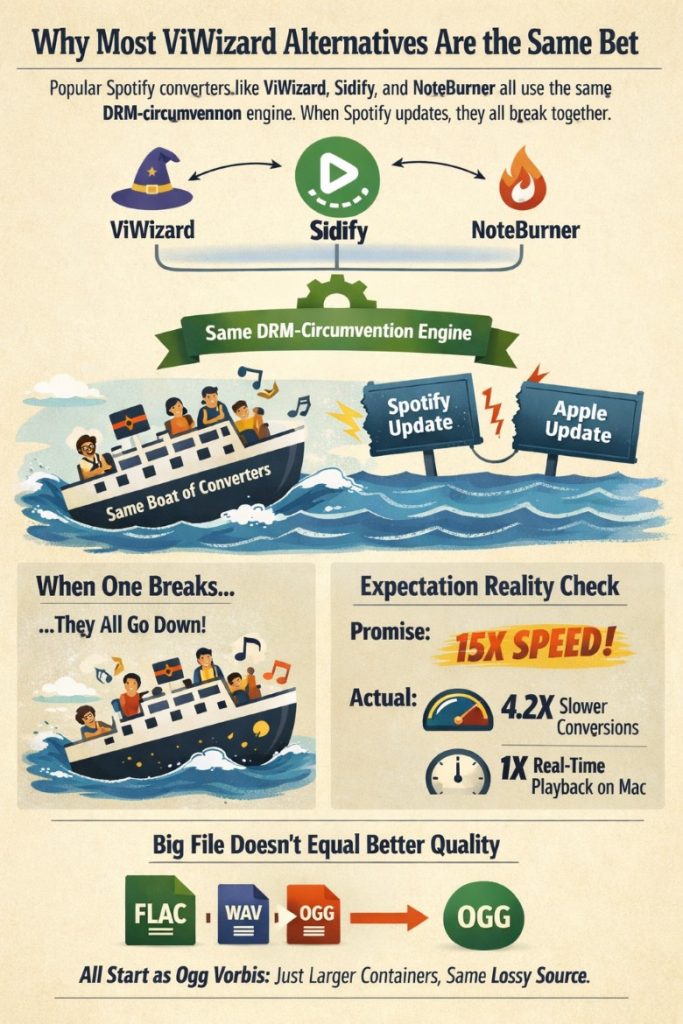
A quick look at ViWizard’s Spotify converter, Sidify’s music converter, and NoteBurner’s converter lineup shows the same basic pitch: sign in, connect to the streaming service, and convert faster than real time. That can work, but it also means these tools tend to share the same weak points.
If Spotify or Apple changes something important, this whole bucket can wobble together. If your real complaint about ViWizard is update breakage, switching to Sidify can feel less like switching ships and more like changing cabins on the same one.
The other hidden issue is expectation mismatch. ViWizard markets very high conversion speeds, but Cinch’s independent ViWizard speed test measured closer to 4.2X rather than the advertised 15X. And recent ViWizard Trustpilot reviews repeatedly mention a harsher reality on macOS: some users report real-time 1X behavior for long audiobooks and podcasts. For a 12-hour book, that means 12 hours, not a quick batch job.
One more myth is worth killing early: exporting Spotify audio to FLAC or WAV does not create new musical detail. Spotify is already delivered in a lossy Ogg Vorbis format on its own side, so a bigger file does not magically become a better source. Think larger container, not better source.
If you want a truly different alternative, pick a different method, not just a different logo.
The Shortlist at a Glance
| Option | Technical approach | Best for | Biggest win | Biggest catch |
|---|---|---|---|---|
| Cinch Audio Recorder | Native system-audio recording with metadata repair | Most readers who want reliability, browser-based Spotify web player recording, and one tool for music, podcasts, and messy existing files | No credential handoff, no virtual sound card required, and less need for a separate ID3 tag editor afterward | Real-time recording, and other sounds on the same output device can still leak in |
| Sidify / NoteBurner / TuneFab bucket | Stream-capture / DRM circumvention tools similar to ViWizard | Windows users who still prioritize faster batch conversion over long-term stability | Can be quicker than real time when stable, usually cleaner from unrelated desktop sounds | Same fragility class as ViWizard, weak trials, Mac speed can collapse to 1X |
| Libation | Audible-specific library manager | Audiobook users who care about audiobook chapter markers more than anything else | Free, open-source, and preserves audiobook chapter markers via .cue support | Not a general Spotify or Apple Music tool |
| Audacity + loopback / virtual cable | Manual recording and editing | Zero-budget users who can tolerate setup and manual cleanup | Free and flexible | Highest setup friction, driver chaos, manual splitting and tagging |
Prices and trial terms were checked on April 3, 2026, but they can change. At that point, ViWizard was roughly a $90 lifetime buy, while Cinch sat around $35.95 for a lifetime license. Trial usefulness matters more than sticker price anyway: ViWizard’s official trial only gives you the first minute of each track, while Cinch gives you 9 full songs and Libation is free to start with.
Cinch Audio Recorder: Best Overall if You Care More About Finishing Than About Marketing Speed
For most people leaving ViWizard, Cinch Audio Recorder’s user guide describes the kind of workflow that actually changes the outcome: no Spotify login, no virtual sound card, broad format support, and the ability to record whatever your computer can play, including Spotify web player recording in a browser. That matters more than a flashy speed number if your real pain is broken clones and constant workaround-hunting.
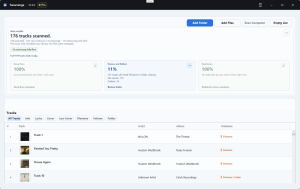
Cinch is a Windows/Mac recorder that captures system audio, then adds song identification, cover art, lyrics, and metadata cleanup. It can also import existing MP3, WAV, FLAC, and M4A files and run re-identification on them, which matters if your old library is full of bad tags and you do not want to live inside a separate ID3 tag editor all afternoon.
It fits Spotify library archivists, people who use more than one audio source, and anyone whose problem is not just “get the song” but also “clean up the file afterward.”
The reason you might pick it: It removes three of the most annoying moving parts at once. You do not hand your streaming credentials to a third-party tool. You do not install a virtual sound card. And you do not need a separate tag fixer or ID3 tag editor after the recording is done.
What you should see in the trial: Run one full song with speaker volume muted to test whether the file still records cleanly. Run another song with normal desktop activity (browser tabs, notifications) to see if background sounds leak in. Import one messy file from your existing library and check whether the metadata repair fixes title, artist, and album. If the tool passes these three checks, you have more confidence than you would from any one-minute demo.
I won’t sugarcoat the downside: Cinch records in real time. If you have a 3,000-song playlist and need it done in ten minutes, this is not your tool. But the trade-off is simple: a 3-minute song takes 3 minutes every time. No freezing at track 799, no silent crashes halfway through a giant queue, and no babysitting split jobs. The one thing you still have to manage is your desktop noise, because a notification, browser tab, or game sound on the same output device can still pollute the file if you record in a messy session.
For large libraries (over 800 songs): Plan your conversion in batches. Real-time recording means 1,500 songs will take roughly 75 hours of recording time (assuming average 3-minute songs). If you have two weeks, that translates to about 5–6 hours per day of active recording sessions. Run Cinch overnight if your computer is stable, or split into morning and evening sessions to avoid interrupting normal computer use. Unlike stream-capture converters, Cinch does not crash at the 700–800 track threshold, so you can queue larger batches without babysitting split jobs.
Skip it if your top priority is faster-than-real-time batch conversion and you are willing to accept the same Spotify dependency and breakage risk that pushed you away from ViWizard in the first place.
The good part is that Cinch’s trade-off is honest. It is 1X because it is recording in real time, not because a “15X” promise quietly collapsed on your Mac. The 9-song trial lets you run the checks that matter: test one quiet session, test one with normal desktop notifications, and import one ugly file to see whether the metadata repair is good enough. That tells you far more than a one-minute demo clip ever will.
For most readers, a slower tool that actually finishes the job is more valuable than a faster one you still have to babysit.
The Converter Bucket: Sidify, NoteBurner, and TuneFab if Speed Is Still Your Main Goal
This bucket stays on the shortlist for one reason: when it works well, it can be faster than real time, especially on Windows. If you only care about getting through albums quickly and you are comfortable living inside the same general converter model as ViWizard, it can still be a rational choice.
The same family of stream-capture or DRM-circumvention style tools that ViWizard belongs to. Different brand, similar core bet.
It fits Windows users with standard music jobs, smaller or medium-size batches, and enough patience to stay on top of app updates and service changes.
The reason you might pick it: This bucket usually keeps unrelated desktop sounds cleaner than full system recording because it is not listening to your whole speaker mix. If speed matters more to you than long-term stability, that can be attractive.
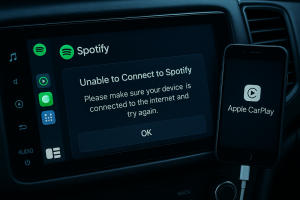
The reality of these stream-capture converters is that you have not solved the problem; you have just bought a new set of headaches. You are still handing your personal Spotify credentials to a third-party app. You are still crossing your fingers every time Spotify updates, hoping the developer patches the tool before your subscription runs out. For large libraries, community reports around ViWizard mention freezes and crashes once jobs get into the 700-800 track range, which means a 1,500-song archive can turn into multiple babysat batches instead of one clean run. This is also where desktop-app hostage syndrome tends to show up: keep the app in the right state, do not interrupt playback, and hope the next patch lands fast.
If your library exceeds 800 songs, avoid this bucket. You will need to manually split your playlists into 3–4 smaller batches, monitor each conversion session, and restart from scratch if a batch freezes mid-way. For a two-week deadline, this adds unpredictable babysitting time that recording-based tools avoid.
Mac users should assume 1X until a trial proves otherwise
This is the part too many roundups hide. Recent user complaints suggest that Mac performance can fall all the way back to real-time for long-form audio. If you are on macOS converting podcasts or audiobooks, treat “5X” or “15X” as a Windows-adjacent best case, not a promise.
That also makes the trial design a real problem. If ViWizard’s trial only converts the first minute of each track, it tells you almost nothing about the two things that actually hurt: long-session stability and long-form speed.
There is also the account question. Spotify’s disabled-accounts policy is enough reason to take credential handoff seriously. Recording audio on your own computer is generally easier to defend than feeding a third-party converter your login, but neither path deserves a lazy “100% safe” label.
So keep this bucket only if you knowingly want speed-first behavior. Do not keep it if your reason for leaving ViWizard is fragility, Mac throttling, or a desire for a truly cleaner setup.
Libation: The Obvious Free Pick if Audiobook Chapters Matter
If your actual pain is Audible, stop comparing music converters and start with Libation’s getting-started docs. This is the clearest example of a tool that changes the shortlist because it solves a different job.
Libation is a free, open-source Audible library tool designed around audiobook ownership and management, not around Spotify-style music conversion.
It fits Mac or Windows audiobook listeners who care about chapter navigation, long-form listening, and not getting stuck with a single giant file.
The reason you might pick it: Libation preserves chapter structure through .cue support. That sounds like a small detail until you are 9 hours into a 15-hour book. At that point, chapters are not a bonus feature. They are the whole experience.
Where it struggles: It is not your all-purpose streaming recorder. If your main job is archiving Spotify, Apple Music, podcasts, and random browser audio in one place, Libation is simply solving a different problem.
Skip it if your main goal is a general-purpose ViWizard replacement for music rather than an Audible-first workflow.
Audacity + Loopback or a Virtual Cable: Best Free Route If Your Budget Is Zero
Audacity makes the list because it is genuinely free and genuinely capable. It also comes with the highest setup tax of anything here.
Audacity is a general audio recorder and editor, not a streaming-specific archiver.
It fits users with zero budget, enough patience to set up routing, and no fear of manual splitting, renaming, and tag cleanup.
The reason you might pick it: Full control and no purchase required. If you are comfortable building your own workflow, Audacity can absolutely capture audio and let you clean it up later.
Where it struggles: This is where the virtual sound card problem shows up in real life. Once you move into loopback devices and virtual cables, you are more exposed to broken system audio, headphone-versus-speaker conflicts, and notification sounds landing in the same recording.
If your priority is system stability, avoid tools that require virtual audio drivers. The setup friction (audio routing conflicts, notification mixing) is significant, and rollback is not always straightforward.
Skip it if you want a true “install it and start archiving” replacement, or you are already tired of audio-routing problems.
If money is the only hard constraint, Audacity is the right free answer. If your time and system cleanliness matter too, it is usually a false economy.
The Practical Tests Most Roundup Articles Skip
Feature lists look helpful until they ignore the stuff that actually ruins your week. Before you pay for any ViWizard alternative, run these tests during the trial.
1) Can it still work in a quiet setup?
Lower or mute your speaker output and see whether the recorded file is still healthy. This sounds trivial, but it tells you whether the tool is tied to one fragile playback arrangement. Official docs are usually much better at listing formats than answering this edge case, so treat it as a must-run trial test, not as a marketing claim.
You should see: A clean recording even with speaker volume muted, proving the tool captures the audio stream rather than relying on speaker output levels.
2) Can it keep background noise out of the file?
Let one notification fire. Open a browser tab. Leave another app running in front. If that sound lands in the file, you now know how much babysitting the tool really requires.
You should see: Either a clean file (converter-style tools) or an audible notification in the file (full-system recorders). This tells you whether you need to run conversion sessions in isolation or can tolerate normal desktop activity.
Converter-style tools usually isolate the target source better than full-system recorders. Full-system recorders give you more service flexibility, but they also need a cleaner desktop session if you care about pristine results.
3) Can it repair a messy library afterward?
Do not test with a perfect track. Test with one ugly file: missing year, missing cover art, bad title, no album. This is where most plain recorders stop helping and where Cinch’s import and re-identify workflow can actually save time after capture, not just during capture.
You should see: Corrected metadata (title, artist, album, year) populated from identification databases. If the tool cannot fix bad tags, you will need a separate cleanup step after conversion, which usually means opening an ID3 tag editor afterward.
This is also why trial design matters so much. A one-minute cap cannot tell you whether a tool handles long sessions, background pollution, or metadata repair. A 9-song full trial can. An open-source audiobook tool can. A clipped demo usually cannot.
Which Tool Fits You
If your library exceeds 800 songs and you need it done without babysitting split batches, Cinch Audio Recorder is the safest escape from the fragility that pushed you away from ViWizard. It trades speed for stability: no credential handoff, no virtual sound card, no 700-track crash threshold.
For Mac audiobook listeners or Audible users who care about navigation more than speed, Libation’s chapter preservation is the decision point—not a side feature.
Windows users who still prioritize faster-than-real-time conversion can stay in the converter bucket, but only if you accept the same breakage risk and service dependence. Do not expect Sidify or NoteBurner to feel different from ViWizard when the underlying method is identical.
The mistake most people make is comparing brand names before they compare technical methods. Pick the failure mode first—slower but steadier, faster but fragile, free but fiddly, or audiobook-specific—then choose the tool that matches it. Test before you buy, especially if your trial window is tight and your library is large.
FAQ
Why is ViWizard only converting at 1X speed on Mac?
Because macOS is stricter about audio-capture permissions, app sandboxing, and the low-level hooks these converter apps like to use on Windows. When those shortcuts stop working, a lot of DRM circumvention tools fall back to behavior that looks much closer to real-time capture. That is why a long audiobook can suddenly turn into an overnight job on Mac.
Does Sidify or NoteBurner use the same technology as ViWizard?
Broadly, yes. They belong to the same family of stream-capture and DRM circumvention tools, so they usually share the same strengths and the same failure points: Spotify login dependence, patch waits after platform changes, and shaky behavior on very large libraries. The branding changes more than the underlying bet.
Is it legal to record Spotify for personal use without logging in?
If by “without logging in” you mean not handing your Spotify credentials to a third-party tool, that is generally the cleaner route. Recording audio that plays on your own machine, including Spotify web player recording in a browser, is usually treated as more defensible than using a converter that wants your login. But laws vary by country, and Spotify’s terms still matter, so treat it as a lower-risk path, not a blanket legal guarantee.
Is it safe to give ViWizard my Spotify password?
That is the part many reviews wave away too quickly. Handing your Spotify password or login session to a converter adds account ban risk you simply do not have with a recorder like Cinch. It also means you are trusting a third-party app with credentials that sit inside Spotify’s terms of service gray zone. If avoiding password handoff matters to you, Cinch’s biggest practical advantage is boring but important: it records what you play and does not need your Spotify login at all.
Why is my Mac audio distorted after uninstalling audio converters?
Usually because the app did not cleanly undo its audio routing changes. Tools that depend on a virtual audio cable or similar low-level drivers can leave behind driver conflicts, broken sample-rate settings, or the wrong output device as your system default. That is why some people uninstall a converter and then discover tinny sound, no output, or weird speaker and headphone behavior afterward.
Can I convert Spotify to lossless FLAC?
Not in the way most converter ads imply. Spotify itself is already a lossy source built around Ogg Vorbis delivery, so converting that stream to FLAC only gives you a lossless container around audio that was already compressed upstream. In plain English: the file gets bigger, but the musical detail does not come back. FLAC can still be useful for archiving workflow consistency, but it is not a magic upgrade from a lossy Spotify source.