
Quick Summary
Your burned Spotify CD won't play in your car. The fix: select Audio CD mode. This guide also exposes free tools pull YouTube audio at 128kbps wasting your disc
Your burned Spotify CD won’t play in your car. The reason: you burned a Data CD (MP3 files) instead of an Audio CD. Select “Audio CD” mode—it works on any player. But the hidden trap? Free converters extract YouTube audio at 128kbps. Your car stereo will expose every flaw.
Why Your Burned Spotify CD Won’t Play in Your Car
If you burned a CD and your car stereo shows “ERROR” or just spins silently, you hit the most common rookie mistake: Audio CD vs Data CD.
Standard Audio CD format stores music as uncompressed audio (technical term: CDDA) at 1411kbps—the same quality as commercial CDs. This plays on any CD player: car stereos, portable players, home systems. Limit: 80 minutes maximum, roughly 15-20 songs.
Data CD (or “MP3 CD”) stores actual MP3 files as data—up to 700MB, which could hold 100+ songs. But your car stereo from 2003 probably doesn’t know what an MP3 file is. It expects CDDA audio tracks, not data files. Modern players with “MP3 CD” support will read it, but that’s not what your 15-year-old car stereo was built for.
The fix: When burning, always choose “Audio CD” (sometimes labeled “Music CD”) in your burning software—not “Data CD,” “MP3 CD,” or “Data Disc.”
The Short Answer: Audio CD = 80 minutes max, works on any CD player. Data CD = 700MB MP3 files, only works if your player explicitly supports MP3 CDs. Most older car stereos don’t.
The Quality Trap: Free Tools and “Fake Lossless”
Here’s the industry’s dirty secret: Free “Spotify converters” don’t download from Spotify at all. They pull audio from YouTube at 128kbps. Burning this to Audio CD (1411kbps) doesn’t improve quality—it amplifies the flaws. You’ll hear muffled highs and thin bass on any decent stereo.
Standard Audio CD runs at 1411kbps uncompressed. If you feed it 128kbps audio, you’re putting garbage in a high-resolution container. CD players don’t smooth over low-quality sources.
Users on Reddit consistently report: “192kbps is awful in comparison.” The sound becomes painfully obvious through a car hi-fi or home stereo. And once burned, that blank CD-R can’t be erased.
To avoid creating permanent “coasters” (wasted blank discs), you need a pure source file in WAV, FLAC, or true 320kbps MP3 before you even open your burning software. If you’re going to the trouble of burning a physical CD for your car or as a gift, don’t ruin it with a 128kbps YouTube rip.
Account Ban Risk: Is Fast Download Worth Losing 5 Years of Playlists?
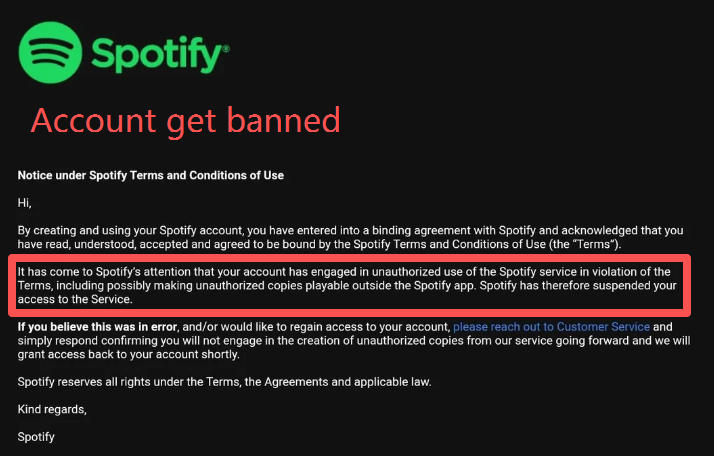
Using API-based “10X speed” converters is the fastest way to get your Spotify account permanently banned. Recording tools that capture system audio have near-zero account risk—they don’t log in, don’t use the API, and don’t trigger anti-crawler detection.
Some Spotify converters advertise “10X speed” and “download without limits.” They work by spoofing Spotify’s API—essentially pretending to be an authorized app while scraping your account data at high speed.
Reddit users have reported bans after using these tools. One user wrote: “Got banned after about four days. Wasn’t running it at 1x speed.” Spotify’s anti-crawler systems detect unusual API activity. When they flag your account, you lose everything—your playlists, your saved albums, your years of history.
We’ve seen users lose 5-year-old Spotify libraries just to burn a single 80-minute mixtape. It’s simply not worth the risk.
The safer approach: 1X speed recording. Tools that record your computer’s audio output don’t interact with Spotify’s API at all. They’re just capturing what your speakers play—no login required, no credentials exchanged, no API traffic. Your Spotify account is never touched, so there’s nothing to detect.
How to Get CD-Quality Audio from Spotify Safely
The prerequisite for CD-quality audio: a source file at WAV/FLAC quality or true 320kbps MP3, recorded cleanly without YouTube proxies or API exploits.
Cinch Audio Recorder captures your computer’s audio output at up to 24-bit/48kHz—well above CD’s 16-bit/44.1kHz spec. Unlike sketchy converters that require virtual drivers, Cinch runs natively on both Windows and macOS, needs no Spotify login, and doesn’t touch the API. Cinch User Guide
How to record (step-by-step):
- Open Cinch and click the big “Record” button
- Open Spotify and play your playlist at normal volume
- Let it play through—Cinch captures everything your speakers play
- Click “Stop” when done. Files save to your Music folder as WAV/FLAC
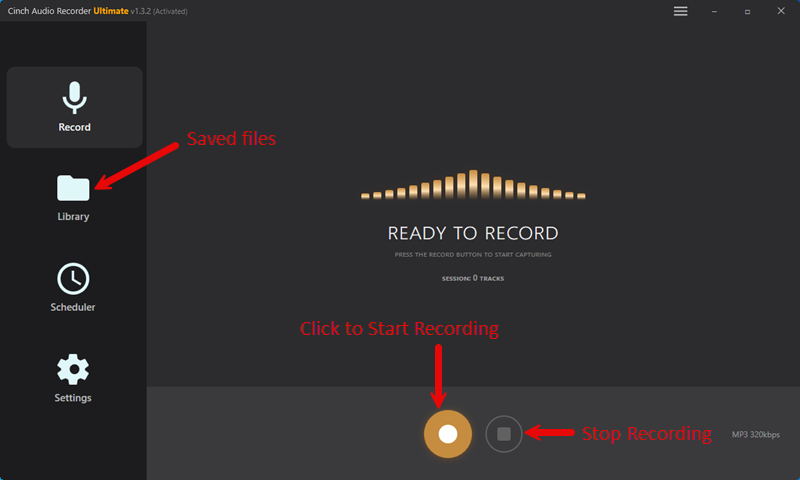
Key points for CD burning:
- Set output format to WAV or FLAC before recording
- Cinch auto-identifies tracks and pulls metadata (title, artist, album art)
- You get properly tagged, high-quality files ready for burning software
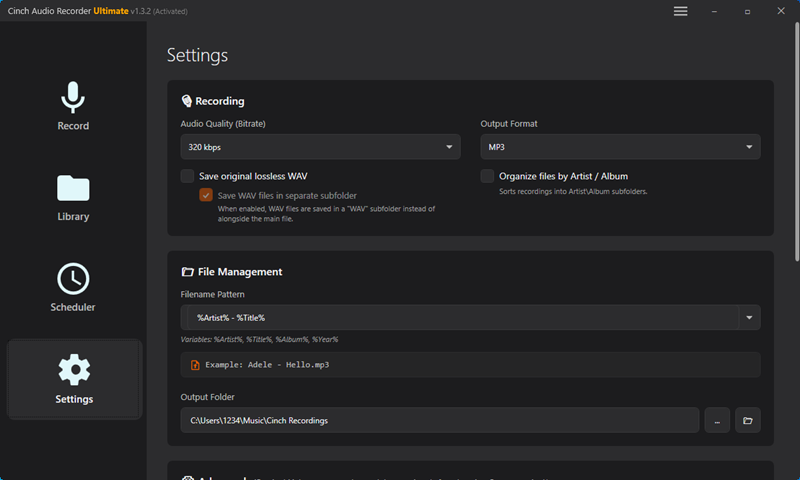
Here’s the real trade-off: you spend 80 minutes recording at normal speed for a 20-song mixtape. But you walk away with tagged files, zero guesswork about quality, and no API footprint for Spotify to detect.
You can download Cinch for a free trial—the trial lets you record up to 9 songs before deciding.
Burn an Audio CD with Windows Media Player
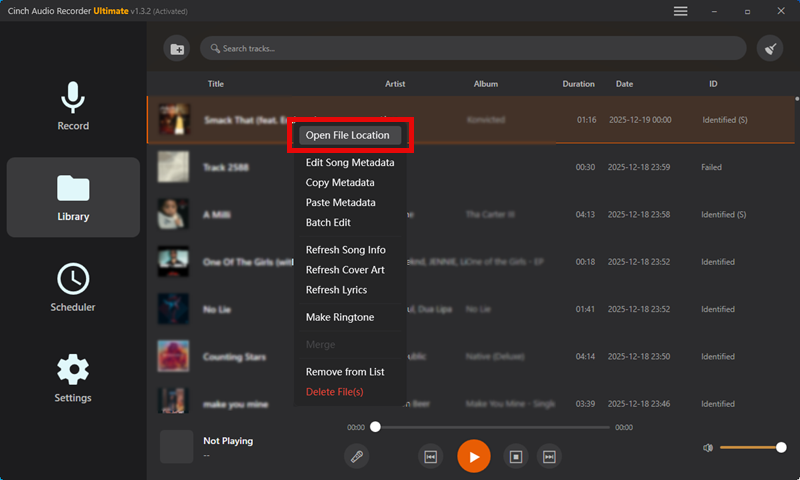
Once Cinch has saved your recordings (righ-click “Open File Location” to find your recordings), you’re ready to burn. Windows Media Player handles the conversion to CD format automatically. Just make sure your computer has a CD/DVD drive that can burn discs—most laptops made before 2018 have one built-in, while newer models may need an external USB drive.
Requirements
- Blank CD-R disc (CD-RW may not work in older car stereos)
- Windows Media Player (built into Windows)
- Audio files totaling ≤80 minutes
Steps
- Open Windows Media Player → Click the “Burn” tab in the top-right corner
- Select burn type → Click the burn options dropdown → Choose “Audio CD” (not “Data CD”)
- Add your tracks → Drag audio files from your library into the burn list panel on the right. WMP shows total duration—stop before 80 minutes.
- Insert blank CD-R → Place disc in your drive
- Click “Start burn” → WMP converts files to CDDA format and writes to disc. This takes several minutes.Pro tip: Before burning, go to Burn options → “More burn options” and select the lowest speed (4X or 8X). Burning at maximum speed often causes skipping on older car CD players. Slower = more reliable.
- Test the CD → Before burning multiple copies, play this CD in your car stereo to confirm it works.

Common mistakes to avoid
- Choosing “Data CD” → Result: CD won’t play in older stereos
- Files over 80 minutes → WMP will truncate or reject
- Using CD-RW discs → Some players can’t read rewritable discs
- Low-quality source files → Sound will be obviously bad on hi-fi systems
Alternative burning tools: iTunes (Mac/Windows) and ImgBurn (Windows, free) also support Audio CD burning. Same rule applies: select “Audio CD” mode, keep tracks under 80 minutes.
How to Burn Spotify to CD on Mac (Using iTunes or Apple Music)
If you’re on a Mac, iTunes (or Apple Music on newer macOS) handles Audio CD burning the same way.
Steps
- Create a playlist → Select your recorded tracks → Right-click → “Add to Playlist” → “New Playlist”
- Open burn settings → Click “File” in the top menu bar → Select “Burn Playlist to Disc”
- Choose Audio CD & Speed → In the burn dialog, select “Audio CD” (not “MP3 CD”). Pro tip: Click the “Preferred Speed” dropdown and select 4X or 8X instead of “Maximum Possible”. Slower burning significantly reduces the chance of skipping in older car stereos. Click “Burn”.
The 80-minute limit still applies. iTunes will warn you if your playlist exceeds it.

What If You Have Live Albums or Gapless Tracks?
Live albums (like a Pink Floyd concept album or a symphony) are meant to flow continuously. But most API-based converters forcefully insert 2-3 seconds of dead silence at every track boundary, instantly ruining the listening experience. Recording tools like Cinch allow you to adjust the “silence detection threshold” so you can preserve those continuous transitions. For classical music (movements that connect), live concerts, and concept albums, this makes the difference between a playable CD and a coaster.
Before You Burn: Quick Checklist
- Test your stereo first: Burn a 5-song test disc before committing to a full 80-minute mixtape. If your stereo is older than 2010, assume it only plays Audio CD format.
- Quality check: Use WAV/FLAC from a recording tool. Free converters = YouTube audio at 128kbps.
- Account safety: Skip “10X speed” API downloaders—they’ve triggered bans. 1X recording = near-zero risk.
- For gift CDs: Tag your files properly, test playback on your car stereo, then burn. Better to spend extra time upfront than waste discs on something that doesn’t work.
Frequently Asked Questions
Why does my burned Spotify CD say “Error” in my car stereo?
You likely burned a “Data CD” (MP3s) instead of an “Audio CD”. Most car stereos made before 2010 cannot read data files—they only recognize standard Audio CD format (CDDA). Re-burn the disc using the “Audio CD” setting in your burning software, which limits the disc to 80 minutes of uncompressed audio.
Can I put Spotify songs on a blank CD for free?
Yes, but there’s a catch. Free online converters extract low-quality 128kbps audio from YouTube music videos, not Spotify. When burned to a CD, this low-quality audio sounds muffled and distorted on car or home stereos. You get what you pay for.
How many Spotify songs can fit on a CD?
If you burn a standard “Audio CD” (recommended for car stereos), it holds exactly 80 minutes of music—usually 15 to 20 songs. If your player supports “Data CDs”, you can fit about 100+ MP3 songs on a 700MB disc, but older car stereos won’t recognize it.

Burning a CD from a Spotfy playlist – you mention a Windows media player. Can this be done from a Mac too?
Many thanks for your help….
Hi Peter, You could download Spotify playlist to MP3 on your computer and then burn it to CD with iTunes.
Can I download music from spotify and transfer to my memory stick.
That’s correct. You can transfer the MP3 files from Spotify to any device that supports playing them.
Maybe I am blind but I do not see the option to convert the Spotify playlist to MP3 or burn to cd. I see that it downloaded my playlist to a folder with subfolders like 0a, 0c, 12, 13, etc. I would gladly purchase a decoder if I had a link.
Thanks