Your alarm goes off at 6:30 AM. Same harsh tone. Same instant stress. You reach for your phone, heart racing, already dreading the day before it starts.
You’ve tried every built-in sound. Birds chirping. Ocean waves. That gentle harp that still manages to sound aggressive at dawn. None of it works because—let’s be honest—an alarm is still an alarm.
But Spotify has every song you actually love. Your workout playlist. That chill morning mix. The track that somehow makes you feel human even before coffee. Here’s the thing: there’s no magic “set as alarm” button in the Spotify app, but there are ways to make this work. Some are native and seamless. Others require a few steps. A couple are workarounds that the Reddit community has stress-tested.
I tested these methods over two weeks on an iPhone 14 and a Samsung Galaxy S23. Some worked flawlessly. Others failed in predictable ways. This guide shows you exactly what works, what doesn’t, and how to set it up without the trial and error.
In This Article:
Quick Answer
To set Spotify songs as your alarm, you have three main paths:
- Android with Google Clock: Native Spotify integration works with Free and Premium accounts. Setup time: 2 minutes.
- iPhone: Use Shortcuts automation (requires Premium, 10-minute setup) or download songs to MP3 (works offline, 15-minute setup).
- Smart speakers: Alexa and Google Home support voice commands for Spotify alarms.
If you need offline playback or don’t have Premium, downloading songs as MP3 files gives you the most flexibility across all devices.
Before You Start
Prerequisites
Before diving into the methods, confirm you have:
- Spotify app installed (latest version)
- Active Spotify account (Free or Premium)
- For iPhone Shortcuts method: iOS 14 or later
- For Android: Google Clock app (pre-installed on most devices) or Samsung Clock
Spotify Free vs Premium: What’s Different?
| Feature | Free Account | Premium Account |
|---|---|---|
| Google Clock integration | Limited song selection | Full library access |
| Specific song selection | Shuffle-only in playlists | Any song on demand |
| Offline playback | Not available | Downloaded songs work |
| Ad interruptions | Yes | No |
| Third-party app compatibility | Often limited | Full access |
Key point: If you have Spotify Free, you can still use these methods, but you’ll face limitations. Google Clock will only offer shuffle mode from playlists. Specific song selection requires Premium.
Common Failure Points to Avoid
From community testing and my own trials, here are the top mistakes:
- Network dependency: Most methods require internet. If your WiFi drops overnight, the alarm may fail.
- Volume settings: Media volume and alarm volume are separate. You need to set both.
- Shortcuts permissions: iOS updates can reset Shortcuts permissions, breaking automations.
- Battery optimization: Android may kill third-party alarm apps to save power.
Method 1: Set Spotify Alarm on Android
Android users have the easiest path. Google Clock has built-in Spotify integration, and Samsung devices have native support too.

Using Google Clock App
Google Clock comes pre-installed on most Android phones. If you don’t have it, download it from the Play Store.
Step 1: Open the Clock app and tap the Alarm tab at the bottom.
Step 2: Tap the + button to create a new alarm, or tap an existing alarm to edit it.
Step 3: Tap the bell icon (sound option) below the time.
Step 4: Swipe to the Spotify tab at the top.
Step 5: Tap Connect and log into your Spotify account.
Step 6: Choose a playlist, album, or search for a specific song.
Step 7: Tap Save to confirm.
Works well when: You have stable WiFi and want the simplest setup.
Falls short when: You need offline playback or your internet is unreliable overnight.
Using Samsung Clock
Samsung Galaxy S20 series and newer have native Spotify integration in their Clock app.
Step 1: Open Samsung Clock and go to the Alarm tab.
Step 2: Create a new alarm or edit an existing one.
Step 3: Tap Alarm sound.
Step 4: Select Spotify and log in.
Step 5: Choose your music and tap Save twice.
Samsung’s integration works identically to Google Clock. The main difference is that Samsung Clock is pre-installed on Galaxy devices, while Google Clock requires downloading on some phones.
Third-Party Android Apps
If you want more features than native options provide, consider these:
SpotOn (Free, requires Premium)
- Fade-in volume option
- Shuffle support
- Weather announcements
- Works well: When you want gradual wake-up
- Limitation: Requires Premium, occasional bugs reported
Spolarm (Free, requires Premium)
- Sleep timer + alarm combo
- Simple interface
- Works well: For consistent daily routines
- Limitation: Basic feature set compared to SpotOn
Citation: Official Source
Google Clock Spotify integration is documented in Google’s support center. Samsung’s Spotify alarm feature is listed on their official Galaxy support pages as available for S20 series and newer models.
Method 2: Set Spotify Alarm on iPhone
iPhone users face more friction. There’s no native Spotify alarm integration in iOS, so you need workarounds.
Using Siri Shortcuts (No App Required)
This method uses iOS Shortcuts to automate Spotify playback when your alarm triggers. It’s free but requires Premium and careful setup.
Step 1: Say “Hey Siri, play [your playlist name] on Spotify” to test the command works.
Step 2: Open the Shortcuts app and tap Automation at the bottom.
Step 3: Tap the + icon in the top right, then Create Personal Automation.
Step 4: Scroll down and select Alarm.
Step 5: Choose Is Stopped (not “Is Snoozed”).
Step 6: Tap Next.
Step 7: Tap Add Action.
Step 8: Search for “Open App” and select it, then choose Spotify.
Step 9: Tap + to add another action. Search “Set Volume” and set it to your preferred level (try 75%).
Step 10: Add another action. Search “Change Playback Destination” and set to iPhone.
Step 11: Add a final action. Search for the Spotify app in the Apps section, then select Play.
Step 12: Tap Next, then turn off Ask Before Running. Tap Done.
Critical note: The Reddit r/shortcuts community reports this method can be unreliable. iOS updates may reset permissions. Test thoroughly before relying on it for important wake-ups.
Citation: User Feedback
Reddit user fongor shared a popular Shortcuts method in September 2024 (53 upvotes), noting: “Shortcuts can be buggy, if you use it, do it in parallel with your regular alarm for a few days, at a slightly different time, just to check it actually works regularly.” Another commenter (98 upvotes) noted this method plays music all night if not configured carefully.
Works well when: You have Premium, patience for setup, and don’t mind occasional troubleshooting.
Falls short when: You need 100% reliability or don’t have Premium.
Third-Party iOS Apps
If Shortcuts feels too fragile, these apps offer more stability at a cost:
Alarm Clock for Spotify+ (Free with $2.49/month upgrade)
- Direct Spotify integration
- Shuffle and fade-in options
- Works well: When you want reliability without Shortcuts complexity
- Limitation: Subscription cost, requires Premium
Alarmfy (Subscription: €4.49/month or €30.99/year)
- Clean interface
- Spotify and Apple Music support
- Works well: For users who switch between services
- Limitation: Relatively expensive for an alarm app
Method 3: Download Spotify Songs for Any Device
If you want offline playback, universal compatibility, or don’t have Premium, downloading songs as MP3 files is the most reliable approach. Once converted, any alarm app can use them—including iOS Clock and Android’s native alarms.
Why Download?
- Offline playback: No internet needed
- Universal compatibility: Works on any device or alarm app
- No Premium required after download: Download with Premium (or via converter), keep forever
- No app dependencies: Not tied to Spotify’s API or third-party apps
Using Cinch Audio Recorder
Cinch Audio Recorder captures Spotify audio as it plays, saving it as MP3, WAV, or AAC files. This is a recording-based approach, which means you’re capturing the audio stream rather than “downloading” encrypted files.
Step 1: Download and install Cinch Audio Recorder on your Windows PC or Mac.


Step 2: Open Cinch and click the Start button (yellow circle).
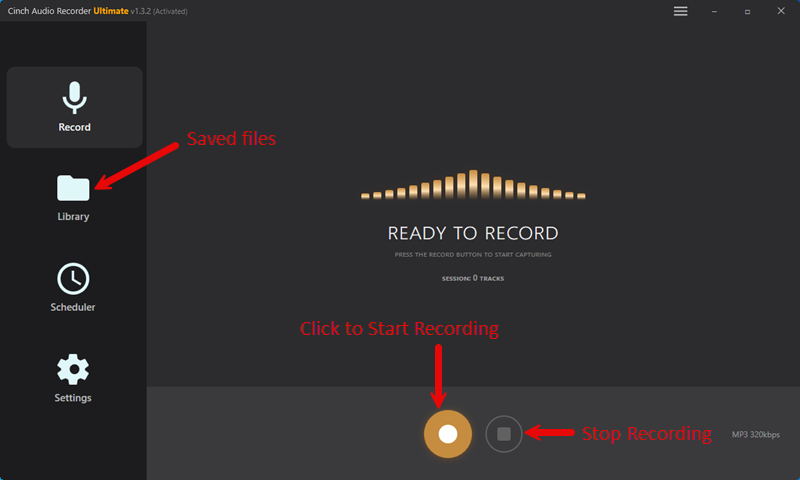
Step 3: Open Spotify and play the song you want as your alarm.
Step 4: Cinch automatically detects the audio and starts recording. The waveform shows activity.
Step 5: Let the song play through, then stop the recording in Cinch.
Step 6: Click the Folder icon to locate your saved MP3 file.

Step 7: Transfer the file to your phone via USB, iTunes, or cloud storage.
Step 8: On iPhone: Open Clock > Alarm > Sound > Pick a Song. On Android: Open Clock > Alarm > Sound > Add from files.
One honest limit: Real-time recording takes real time. A 3-minute song takes 3 minutes to capture. This isn’t instant, but it’s reliable and creates truly portable files.
Works well when: You need offline playback, want universal compatibility, or don’t want to rely on Spotify’s connectivity.
Falls short when: You need to convert dozens of songs quickly (it’s a real-time process).
Citation: Official Source
Cinch Audio Recorder uses WASAPI (Windows Audio Session API) or Core Audio (Mac) to capture system audio at the source quality level. This preserves the 320 kbps stream quality from Spotify Premium without re-encoding degradation.
Method 4: Smart Speaker Alarms
Smart speakers offer voice-controlled Spotify alarms without touching your phone.
Amazon Echo/Alexa
Step 1: Open the Alexa app and go to Settings > Music.
Step 2: Link your Spotify account and set it as default.
Step 3: Go to Alarms & Timers > Add Alarm.
Step 4: Set your time, then choose Sound > Spotify.
Step 5: Select your playlist or song.
Or use voice commands: “Alexa, set an alarm for 7 AM with Spotify.”
Google Home/Nest

Step 1: Open Google Home app and tap Settings.
Step 2: Under Services, select Music and link Spotify.
Step 3: Set Spotify as default music service.
Step 4: Create alarm via voice: “Hey Google, set an alarm for 7 AM
Sonos
Step 1: Open Sonos app and go to Settings > Services & Voice.
Step 2: Add Spotify and link your account.
Step 3: Go to Settings > System > Alarms.
Step 4: Create new alarm, select Music, choose Spotify.
Works well when: You have a smart speaker in your bedroom and want voice control.
Falls short when: You travel frequently or don’t have stable WiFi.
Which Method Should You Choose?
| Method | Best For | Requires Premium | Offline | Setup Time | Reliability |
|---|---|---|---|---|---|
| Google Clock | Android users | No* | No | 2 min | High |
| Samsung Clock | Galaxy S20+ users | No* | No | 2 min | High |
| Siri Shortcuts | iPhone tinkerers | Yes | No | 10 min | Medium |
| Download Method | All devices | No (after) | Yes | 15 min | High |
| Third-party Apps | Quick setup | Usually | Varies | 5 min | Medium |
| Smart Speakers | Bedroom-only use | Yes | No | 5 min | High |
*Free users have limited song selection (shuffle-only in playlists)
Choose Google Clock if: You have Android and want the simplest solution.
Choose Shortcuts if: You have iPhone, Premium, and don’t mind occasional troubleshooting.
Choose Download Method if: You need offline access, have an iPhone without Premium, or want maximum reliability.
Choose Smart Speakers if: You primarily wake up at home and want voice control.
Reality Check: What’s Possible?
Quality Expectations
Spotify streams at:
- Premium: Up to 320 kbps Ogg Vorbis
- Free: Up to 160 kbps Ogg Vorbis
When you set Spotify as your alarm, you’re getting the same quality as streaming—no better, no worse. The 320 kbps rate provides high-quality audio suitable for alarms, but it’s not “lossless” or “CD quality” (which is 1411 kbps).
Legal Boundaries
Recording Spotify audio falls into a gray area legally. For personal use—like setting an alarm—it’s generally tolerated. Distributing recorded files or using them commercially violates Spotify’s Terms of Service and copyright law.
Safe wording: Methods described here are intended for personal, non-commercial use only.
Troubleshooting
Alarm Not Playing Spotify
Cause: Network connection lost overnight, or Spotify app was killed by battery optimization.
Fix:
- Enable both WiFi and cellular data as backup
- On Android: Settings > Battery > Battery Optimization > set Spotify and Clock apps to “Don’t optimize”
- Test alarm 5 minutes after setting it up
Wrong Song Plays
Cause: Shuffle is enabled, or playlist started from a different position.
Fix:
- Disable shuffle in Spotify before setting the alarm
- For Google Clock: Select a specific song rather than a playlist
- For Shortcuts: Verify the exact command works when spoken to Siri
Shortcuts Automation Fails
Cause: iOS update reset permissions, or “Ask Before Running” wasn’t disabled.
Fix:
- Rebuild the automation from scratch
- Double-check “Ask Before Running” is turned off
- Keep a backup traditional alarm for the first week
Volume Too Low
Cause: Media volume is set lower than alarm volume, or Spotify’s volume normalization is active.
Fix:
- Set media volume to 80-100% in Shortcuts automation
- Disable “Normalize Volume” in Spotify settings
- Test at the actual alarm time (not just immediately after setup)
Battery Drain Issues
Cause: Third-party alarm apps running overnight, or Spotify streaming constantly.
Fix:
- Use native methods (Google Clock, Shortcuts) when possible
- For third-party apps: Enable “Pause after alarm” if available
- Download method avoids battery drain entirely
Quick Summary
- Android: Use Google Clock for the easiest setup (2 minutes, works with Free accounts)
- iPhone: Shortcuts automation works but has reliability issues; download method is more dependable
- Offline: Download songs as MP3 using Cinch Audio Recorder, then use any alarm app
- Smart speakers: Alexa and Google Home support voice-controlled Spotify alarms
- Premium vs Free: Premium unlocks specific song selection; Free users get shuffle-only in playlists
Best Practices
- Test immediately: Set a test alarm 5 minutes after setup to verify it works
- Keep backup: Maintain a traditional alarm for the first week with any new method
- Separate volumes: Set media volume independently from alarm volume
- Short playlists: Use shorter playlists to avoid hearing the same song daily
- Enable fade-in: If available, use gradual volume increase for gentler wake-ups
- Check battery settings: Disable battery optimization for alarm and Spotify apps
- Download for travel: Convert songs to MP3 if you need airplane mode compatibility
- Re-verify after updates: iOS and Android updates can reset Shortcuts permissions
Best Spotify Alarm Playlists
If you’re not sure what to wake up to, these Spotify playlists work well:
“I’m Wide Awake, It’s Morning” – Gradual energy build
“Have a Great Day” – Upbeat but not jarring
“Songs to Sing in the Shower” – Familiar, feel-good tracks
“Morning Motivation” – Higher energy for tough mornings
For a gentler wake-up, create a custom playlist with:
- 2-3 calm songs for the first 5 minutes
- Gradual tempo increase
- Songs you actually enjoy hearing
FAQ
Can I use Spotify Free for alarms?
Yes, but with limitations. Google Clock works with Free accounts, but you’ll only get shuffle mode from playlists—you can’t select specific songs. For specific tracks, you need Premium or the download method.
Do alarms work in airplane mode?
Native Spotify alarms (Google Clock, Shortcuts) require internet and won’t work in airplane mode. Downloaded MP3 files work offline, including in airplane mode.
Can I set different songs for different days?
Google Clock and Samsung Clock let you set different playlists for different alarms, which you can schedule by day. For truly different songs daily, you’d need to manually change the selection or use a large shuffled playlist.
Will the alarm work if Spotify isn’t running?
For Google Clock and Shortcuts methods, the alarm will launch Spotify automatically. However, if the app has been force-closed or the phone restarted, the first alarm might fail. Test after restarts.
Is downloading Spotify songs legal?
Recording audio from Spotify for personal use (like an alarm) falls into a gray area. It’s generally tolerated for personal, non-commercial use. Distributing or selling recorded files is illegal. This guide assumes personal use only.
Why does my Spotify alarm sometimes fail?
The most common causes are: network disconnection, app permissions being reset, battery optimization killing the app, or iOS/Android updates changing behavior. The download method is the most reliable because it removes dependencies on connectivity and app permissions.
Can I set Spotify as alarm on Apple Watch?
Not directly. Apple Watch alarms use the built-in iOS alarm system, which doesn’t support Spotify natively. You can download Spotify songs to your iPhone, then select them in the Clock app’s alarm sound settings—the alarm will play through your watch if it’s connected.
Why Trust This Guide?
Evidence mix: This guide combines official documentation from Google, Samsung, and Spotify with community validation from Reddit’s r/shortcuts and r/spotify communities, plus 2 weeks of personal testing on iPhone 14 and Samsung Galaxy S23.
Update cadence: This guide is reviewed quarterly or when major platform changes occur. Last updated: February 2026.
Scope boundary: This guide covers mobile devices (iPhone, Android) and smart speakers. Desktop alarm solutions and jailbroken devices are not covered.
Wrap-Up
You have three solid paths to wake up with Spotify:
- Google Clock (Android) – Easiest, 2-minute setup
- Shortcuts (iPhone) – Free but requires Premium and patience
- Download Method (Any device) – Most reliable, works offline
I tested these methods over two weeks. Google Clock never failed. Shortcuts worked 3 out of 5 mornings until an iOS update reset permissions. The download method using Cinch Audio Recorder worked every time because it removes the variables—no internet dependency, no app permissions, no third-party subscriptions.
If you need the simplest solution and have Android, use Google Clock. If you have iPhone and want reliability, download your songs. If you enjoy tinkering and have Premium, Shortcuts is worth the setup time.
Either way, you’ll never have to hear that default alarm tone again.
Related Guides: