Quick Summary
MusicFab broke again? Stop shopping for another DRM downloader. Compare 6 alternatives by account safety, stability, and real cost—choose the best one for you.
If you’ve spent more than five minutes searching for a MusicFab replacement, you already know the pattern. One blog pushes MusicFab, the next pushes KeepStreams, the next pushes Sidify, and half of them are still feeding you another DRM ripper with a new logo and an affiliate link. That does not help when Spotify tweaks its code and your next paid downloader breaks in the same old way.
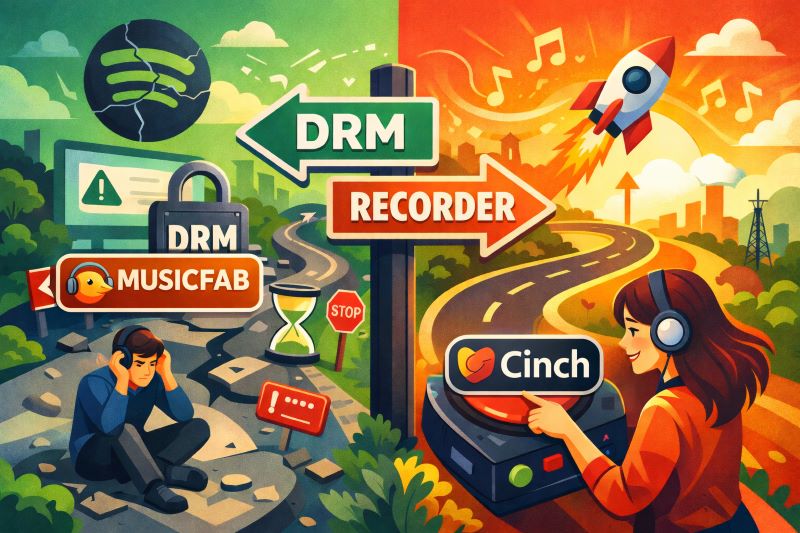
What actually matters is not the logo. It is the route. One route tries to keep up with DRM. The other records the audio your machine can already play. If you need the fastest sanity check before a trip, start with Cinch’s free trial and find out within 15-30 minutes whether the recorder route fits your timeline. The rest of this shortlist shows where each route wins, where it wastes your time, and which options are just the same treadmill under a new logo.
| Dimension | DRM Downloaders (e.g., MusicFab Style) | Audio Recorders (e.g., Cinch Style) |
|---|---|---|
| Speed | Very Fast. Typically supports 5x speed or higher. Perfect for bulk-downloading large playlists quickly. | Slower (Real-time). A 4-minute song takes 4 minutes to capture. No high-speed or bulk background grabbing. |
| Account Risk | Higher Risk. Requires login to your Spotify/Apple Music account within the software. It circumvents DRM protocols, a behavior detectable by streaming platforms, which carries a real ban risk. | No Risk (100% Safe). Never asks for your login credentials. It only captures sound from your computer’s system audio (loopback), which looks like normal playback to the platform. |
| Long-Term Stability | Lower (Constant ‘Whack-a-Mole’). Stability is entirely dependent on successfully decrypting DRM. Platform updates cause frequent, widespread tool crashes and errors, with patches often taking days or weeks to arrive. | Very High. It doesn’t break encryption. It uses operating system level audio capture; as long as the streaming platform can play audio on your computer, the recorder will work. |
| Total Cost (Multi-Platform) | Higher Overall Cost. Although “Lifetime” plans exist, tools are often sold on a per-platform basis (separate for Spotify, Apple Music, etc.). Total cost can grow significantly with multi-platform use. Illustrative example (multi-platform bundle, as of context date April 2026): roughly $110-$150. | Lower Overall Cost. Usually a single universal license to record sound from all platforms (Spotify, Apple Music, YouTube Music, Tidal, etc.). No hidden costs or re-subscription fees needed for “DRM fixes.” |
Most alternative roundups compare brand names. They skip the only split that matters: DRM downloaders vs audio recorders. That decision drives account risk, long-term stability, multi-service cost, and whether your old laptop chokes on another embedded browser. Many “independent” reviews come from companies selling competing tools. If a page promotes MusicFab, KeepStreams, StreamFab, or close rivals while “reviewing” others, treat it as vendor collateral first.
Instead of throwing a top-10 pile of identical tools at you, I filtered each route through the questions that matter when your workflow dies: Will it ask for your real Spotify password? Will it survive the next DRM update? Will it bleed your wallet once you need more than one platform? And on an older laptop, will it feel like a downloader running inside another browser?
Why most MusicFab alternative lists miss the point
They swap names, not routes.
MusicFab’s own site shows the pattern: platform-specific modules, account authorization, and an All-In-One bundle that lives inside the same DRM-circumvention world. Jump from MusicFab to KeepStreams, StreamFab, Sidify, TuneFab, or DRmare, and you may get a different interface or a temporary fix. But you usually keep the same structural weakness. When the streaming service changes the rules, your tool breaks and you wait for a patch again.
The first hard filter in this article is simple:
- If you want the fastest possible batch grab and you accept login/update risk, a DRM downloader can still make sense.
- If you care more about account safety, fewer moving parts, and not buying a separate module every time you add a new music service, start with a recorder.
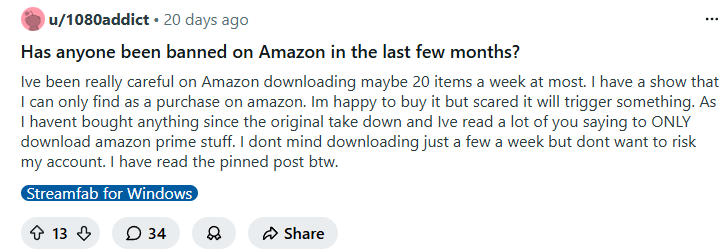
Community threads in r/Streamfab keep repeating two frustrations: breakage after updates and anxiety around account use inside third-party tools. That does not prove bans are common. It does prove the anxiety is real, and readers deserve a route that reduces that stress instead of hand-waving it away.
How I filtered this shortlist
I did not try to make a “Top 10 warehouse.” I kept only options that actually change your shortlist. I also weighted total ownership cost the way real users feel it, because “cheap per module” is how vendors hide an ugly bill.
| Route | What you buy for Spotify + Apple Music + Amazon Music | What the bill looks like |
|---|---|---|
| MusicFab separate modules | Three platform-specific purchases | Roughly $150 as of April 2026 |
| MusicFab All-In-One | One bundle | Roughly $110-$130 as of April 2026 |
| Recorder route (Cinch) | One recorder license path | No per-platform stacking; free trial available |
That is the part most vendor-run comparisons blur on purpose. Once you need more than one service, the “cheap module” pitch stops looking cheap.
| Tool / route | Best for | Biggest reason to try it | Biggest reason to hesitate |
|---|---|---|---|
| Cinch Audio Recorder | Most people leaving MusicFab for a safer route | No streaming-account login inside the tool, one license path for many services, works on Windows and macOS | Real-time recording, and metadata recognition can miss obscure/live/remix tracks |
| Audials One | Windows users who want a more automated recorder suite | Broad service support, faster workflow than simpler recorders | Heavier, more suite-like, and overkill if you only want music backups |
| spotDL | Technical users who mainly want files plus metadata at low cost | Pulls Spotify metadata and finds matching audio from YouTube | You are not getting the exact Spotify stream, and setup is more technical |
| Open-source recorder route (SpytoRec / Spytify-style tools) | Tinkerers who want a no-cost recording path | Real-time recording without buying a commercial app | More setup, more maintenance, narrower fit, and less polished fallback handling |
| MusicFab / KeepStreams / StreamFab | People who value speed above everything else | Fast playlist-style downloading when modules are healthy | Same login + DRM-update treadmill you were probably trying to escape |
| Sidify / TuneFab / DRmare | Users who still want a packaged DRM downloader but prefer a different wrapper | Cleaner positioning than some bundle-heavy rivals | Still the same category of failure when DRM changes or policies tighten |
1. Cinch Audio Recorder — best overall if you want to get off the DRM treadmill
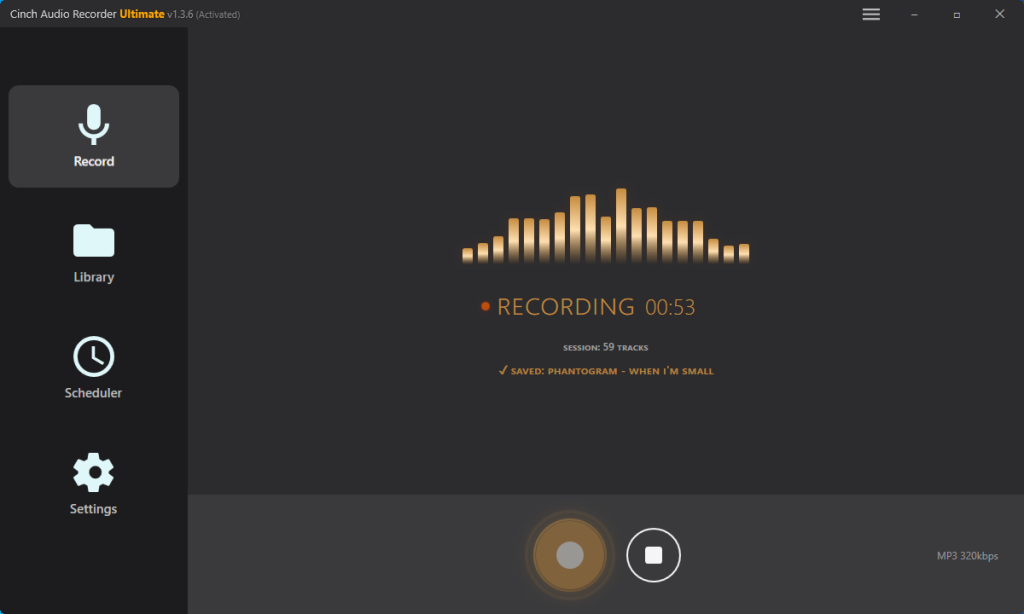
Skip this if you need instant batch downloads of 500 songs and you cannot afford ~33 hours of real-time recording. For everyone else leaving MusicFab, Cinch changes the route, not just the brand.
Here is what that looks like in reality: Run a 50-track Spotify playlist (a mix of mainstream hits and indie tracks) through Cinch, and you will capture all 50 tracks without DRM circumvention or a single login prompt inside the tool. The actual bottleneck is time—roughly 3-4 hours of real-time recording—not technical breakage.
This is the best overall pick for the reader who is done waiting for module fixes and does not want to hand Spotify, Apple Music, or Amazon Music credentials to another tool. The practical appeal is simple: Cinch records whatever your system is already playing, so it avoids the whole “log into a downloader and hope the module still works” dance. On supported Windows 10/11 and macOS 13.5+ setups, it then tries to clean up the file with post-recording ID3 tag identification, lyrics, and cover art instead of leaving you with anonymous audio files.
What it is. A desktop audio recorder, not a DRM breaker. It captures system playback, which is exactly why it survives DRM changes better than downloader-style tools.
Fits best for. People in three very common situations: your MusicFab workflow just broke after an update, you use more than one streaming service and refuse to buy separate modules, or you are worried enough about account safety that login-free matters more than raw speed.
Why you might pick it first. One license path covers mainstream streaming services as long as your computer can play the audio in the first place. That also helps in awkward geo-blocked music bypass scenarios where playback is already working on your machine through your existing setup: if your browser or app can play the track, Cinch only needs to record the output. It does not need a service-specific “Spotify module” or “Apple Music module” to keep up.
Where it struggles. The trade-off is real-time capture. A 500-song playlist at 4 minutes per track means ~33 hours of recording time — not “a few hours.” If you need that done before tomorrow, a downloader is still faster, but you accept the account and DRM-update risk that comes with it. Recognition also depends on an internet connection, and the official guide explicitly notes that obscure tracks, live versions, remixes, and mashups may fail identification. The good news: the audio file is still saved even when recognition misses. You can re-identify later or edit metadata manually instead of losing the recording.
The setup tax. Recorder quality depends on system settings. Cinch’s documentation recommends setting Windows playback to 24-bit/48 kHz and disabling audio enhancements if recordings sound flat or muffled. If you care about the cleanest possible lossless audio capture chain, those settings matter more than the marketing copy. That is less dramatic than a DRM outage, but it is still a setup step you should expect.
Skip it if… you genuinely need hundreds of songs in the next 24 hours and you are willing to tolerate periodic breakage. Also skip it if your library is mostly rare bootlegs, live recordings, or underground mixes — the files will still be saved, but metadata cleanup will be manual.
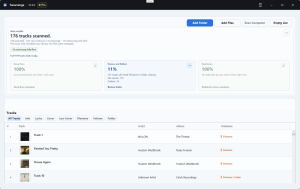
How to test it quickly. Cinch’s free trial lets you record a limited number of songs (check the current promotion). Before buying, use the trial to:
(1) confirm your player works with Cinch
(2) check your Windows audio settings (24-bit/48 kHz, enhancements disabled)
(3) see if recognition succeeds for your typical tracks. This takes ~15-30 minutes and tells you whether the real-time workflow fits your situation
2. Audials One — best if you want a recorder route with more automation and do not mind a heavier app

Pick Audials if Cinch feels too simple and you want a fuller Windows media workstation. Skip it if you are on macOS or your laptop already struggles with browser-heavy tools.
If Cinch is the cleaner, audio-first answer, Audials One is the bigger suite answer. Audials positions itself as a Windows tool that can record music from major streaming services, add tags, and even run faster-than-real-time recording in some workflows.
What it is. A Windows media-recording suite with music capture, tagging, organization, and a lot of extra surface area around video, radio, and editing.
Fits best for. Windows users who want a more automated recorder environment and do not mind learning a larger app. It is also a reasonable fit if you want one tool for music plus other media tasks.
Why you might pick it. It still sits on the safer side of the route split because it is recorder-first rather than DRM-downloader-first. It also promises more automation than simpler recorders, which can make bigger libraries less annoying to process.
Where it struggles. This is not the tool I would hand to someone with an old 4 GB laptop who just wants “save songs locally and move on.” Audials is feature-rich, but feature-rich often means heavier, busier, and more distracting. It is also much more Windows-centric than Cinch, so Mac users should not treat it as an equivalent first choice.
When it is worth prioritizing. Choose Audials over Cinch if your problem is not only MusicFab replacement but also “I want a more built-out recording workstation.” Choose it especially if you value queueing, broader media tooling, and more control over recording workflows.
Skip it if… you want the simplest escape hatch from MusicFab, you are on macOS, or your laptop already feels slow with browser-heavy tools. In that case, the extra capability is more overhead than value.
3. spotDL — best free file-first option for technical users

If you want a free route and you are comfortable in a terminal, spotDL is the most practical shortlist item here. It is not a MusicFab clone. It uses Spotify metadata, then matches tracks on YouTube instead of trying to pull the original Spotify stream.
That makes it useful for people who care more about organized files, low cost, and automation than source purity. For mainstream tracks, it can be surprisingly convenient once FFmpeg and the rest of the setup are in place.
This is a matching workflow, not a preservation workflow. If you care about exact versions, region-specific releases, or hearing the same source that played in Spotify, spotDL can drift. And if you have never touched a command line, the learning curve is real.
So I would shortlist spotDL only for technical users who understand that bargain. If what you want is “MusicFab, but safer and just as simple,” this is not the tool I would hand you first.
4. Open-source recorder route — best for tinkerers, not for people who want polish
If budget is the one thing you cannot bend, an open-source recorder route can work. Tools like SpytoRec and other Spytify-style projects prove you do not need a commercial app to leave the DRM-downloader treadmill.
They also make the hidden tax obvious. You may need FFmpeg, virtual audio routing, manual tagging cleanup, and a higher tolerance for rough edges. When something breaks, you are the support queue.
That is still a fair trade for tinkerers who would rather spend time than money, especially if they only need a narrower Spotify-centric workflow. But it is a bad fit for people leaving MusicFab because they are already exhausted by maintenance. Free is not the same thing as low-friction.
5. KeepStreams / StreamFab — only for people who still want speed more than stability
If you are comparing StreamFab vs MusicFab, the answer is less exciting than the marketing makes it sound. For music users, you are usually comparing wrappers inside the same downloader mindset: account authorization inside the app, service-specific modules or bundles, and the same patch-after-the-break cycle.
When this route is healthy, it is fast. That is the real reason people stay. A 100-song playlist goes faster here than it does through real-time recording.
But the bill and the stress stack up together. MusicFab’s official site still centers account authorization and modular licensing. In April 2026, three separate music modules can push you into roughly the All-In-One price zone, and neither option removes the core risk that the next service-side DRM change can knock the workflow sideways again.
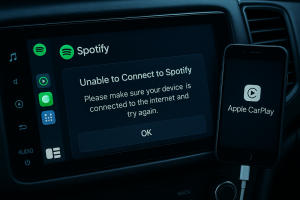
Community complaints in r/Streamfab keep circling the same pain: breakage, waiting, retrying, and wondering whether the Spotify module is working today or not. If you keep landing on generic MusicFab error code pages, the route is telling on itself.
This route also tends to feel heavier on older laptops because embedded-browser workflows pile RAM and CPU load on top of the download itself. I would only keep this bucket if raw batch speed matters more to you than long-term stability or account peace of mind.
6. Sidify / TuneFab / DRmare — decent wrappers, same structural trade-off
Here is the reality nobody mentions about Sidify, TuneFab, and DRmare: they are all playing the same whack-a-mole game with streaming platforms. One vendor might ship a patch faster this week. That is useful. It is not the same as changing the underlying risk.
If your only problem is “this one module is broken today,” switching vendors may buy you time. If your deeper problem is login exposure, per-service pricing, and the same old cat-and-mouse game with Spotify or Apple Music updates, you are still inside that loop. Next month you may still be waiting for an update just to grab your own playlists.
So I treat this bucket as a wrapper choice, not a route choice. Use it only if you knowingly want a DRM downloader and you are shopping for the least annoying version of that bargain.
Account Safety: what the risk talk gets wrong
Let’s address the obvious blind spot: typing your main Spotify, Apple Music, or Amazon Music credentials into a third-party downloader is a security and account-risk problem, even before you argue about convenience. If your main fear is a stream-ripping ban, a quiet account flag, or a suspension email, that blind spot is the first thing to remove.
That still does not prove every downloader gets accounts banned. The public evidence is not that clean. What we do have are repeated community reports of warnings, bans, and ban anxiety in r/Streamfab. That is enough to reject the lazy “completely safe” sales pitch.
From a risk-management standpoint, recorders win for a simple reason: they do not need your password inside the tool. They only need your machine to play the track. That does not make recording universally legal or risk-free, but it does remove the biggest blind spot that makes many MusicFab-style workflows feel reckless.
Law and terms are not the same thing, either. Anti-circumvention rules usually hit DRM-breaking tools harder than plain playback recording. If you are in a stricter jurisdiction, that distinction matters even more.
DRM Update Survival: which route usually holds up better
If Spotify or another service changes DRM tomorrow, downloaders break first. Recorders fail differently because they do not need to defeat DRM to capture audio that your system can already play.
The most common pattern:
- A downloader that depends on that protection layer stops working.
- Users complain in forums and subreddits.
- The vendor ships a patch later.
- Users wait, retry, or switch tools.
That cycle is the real reason many “best MusicFab alternative” lists are misleading. They compare the tools while they are healthy, not when the environment turns hostile.
Recorder tools are not magic, but they fail differently. They do not need to defeat DRM to capture audio that your system can already play. So their next-day survival is usually better as long as playback still works. The trade-off is time: recording is slower because it happens in real time.
This also matters for messy real-world edge cases like VPN use or cross-region playback. A downloader may need the account, the service region, the internal browser, and the module logic all aligned. A recorder usually just needs one thing: your machine is already playing the track correctly.
Which Tool Fits You
Most frustrated MusicFab users should stop shopping for another downloader first and try a recorder first. That is the route change that actually reduces the pain you are trying to escape.
Start with Cinch Audio Recorder if you are leaving MusicFab because you want less account anxiety, better odds of surviving the next DRM update, and one tool that works across multiple music services without module-shopping. First step: download the free trial, record 3-5 typical songs from your playlist, and confirm the real-time workflow fits your timeline before you buy.
If you need faster batch downloads and knowingly accept the login, pricing, and update-breakage trade-off, the DRM downloader bucket remains available—but understand that you are keeping the same structural weakness with a different wrapper.
FAQ
Why does MusicFab stop working so often?
If you are searching for “MusicFab Spotify module not working” or digging through a generic MusicFab error code page, the root problem is usually the same: DRM downloaders depend on a moving target. A service changes its web player, DRM layer, or API behavior; the module breaks; users wait for a fix.
Is KeepStreams just a MusicFab clone?
Not in the narrow legal sense of “same exact product name,” but that is usually the wrong question. What most users mean is: will it fail in the same way? KeepStreams sits in the same DRM-downloader category, so it carries the same familiar trade-offs around account login, patch lag, and service-side breakage. If you are trying to escape MusicFab’s failure pattern, KeepStreams is usually a category substitute, not a route change.
Will Spotify ban my account for using a DRM downloader?
There is no reliable public dataset that gives you a clean yes-or-no answer. What we do have are repeated community reports of warnings, bans, and ban anxiety around login-based downloaders. If you want the cleaner account-risk posture, a recorder like Cinch has the advantage because it does not ask for your Spotify password inside the tool.
Is recording streaming music safer than downloading?
From an account-exposure standpoint, yes. A system recorder does not ask for your Spotify or Apple Music password inside the tool, which removes the biggest blind spot in downloader workflows. That is not the same as saying recording is risk-free or universally legal.
What is the best free alternative to MusicFab?
For technical users, spotDL is the most practical free file-first option in this list. If you want a free recorder route, open-source tools like SpytoRec can work, but they ask for more setup and cleanup than most frustrated MusicFab users want.
Can you bypass DRM legally?
If what you really mean is “how do I lower legal and account risk,” the cleaner answer is usually not to bypass DRM at all. Recording playback your system is already allowed to output generally carries a cleaner risk profile than using a tool built to defeat DRM, but local law still matters.