I ran a test last month. Bought 12 tracks from Traxsource on my studio PC. Two weeks later, switched to my laptop for a gig. Logged into my account, found my purchase history—but the download buttons were gone.
Turns out Traxsource has a download window. About 7 days. After that, you need to contact support to re-enable downloads. Neither of the top Google results mention this. They just tell you to click “Download” like it’s always there.
This guide covers the full picture: official download methods, the time limits you need to know, how to verify your MP3 quality, and a recording alternative for when you just need a few tracks without buying the whole catalog.
Tested in December 2025.
In This Article:
What is Traxsource?
Traxsource is an online platform focused on electronic music, offering a vast catalog of house, techno, deep house, and related genres. It stands out for its curated playlists, exclusive releases, and high-quality audio formats. Users can browse by genre, artist, or chart, making music discovery easy and enjoyable. The platform is popular among DJs for its professional-grade tracks and among enthusiasts for its user-friendly experience.
The platform distinguishes itself through:
- Curated Content: Expert-selected tracks and charts from top DJs and producers
- Pre-release Exclusives: Access to tracks weeks before their official release
- DJ-Friendly Features: Precise genre categorization and DJ-specific tools
- Higher Quality Audio: Available in WAV, AIFF, and MP3 formats
The Official Way: Buy and Download from Traxsource
Traxsource is a paid music store. Unlike Spotify or Apple Music, you’re buying individual tracks—not renting access. That’s the good news. The files are yours. The catch? You need to download them within a limited window.
Method 1: Download via Browser
The most straightforward approach. Works on any computer.
Steps:
- Log into your Traxsource account
- Add tracks to your cart (browse by genre, chart, or search)
- Choose your format at checkout:
- MP3 — $1.49 per track (320kbps)
- WAV — $2.49 per track (lossless)
- AIFF — $2.49 per track (lossless, Apple-friendly)
- Complete payment
- Hover over the Traxsource logo → click Downloads
- Click the blue Download button next to each track
That $1 difference between MP3 and WAV? For most club gigs, you won’t hear it. I’ll explain why in a later section.
Method 2: Traxsource Download Manager (Windows Only)
If you’re buying in bulk, the official desktop app saves time.
Features:
- One-click batch downloads
- Custom folder structure
- Resume interrupted downloads
Steps:
- Download the Traxsource Download Manager from their website
- Log in with your Traxsource credentials
- Your purchased tracks appear in “Available Downloads”

- Select tracks → click the Download icon


The app is Windows-only. Mac users are stuck with the browser method. Not ideal, but it works.
The Free Alternative: Record Traxsource with Audio Capture Software
Not everyone wants to pay $1.49+ per track. Maybe you’re a new DJ building a collection. Maybe you just want to test a few tracks before committing.
Audio recording software captures whatever plays through your computer’s sound system. It’s the digital equivalent of recording from radio onto cassette tape—legal for personal use.
How It Works
- You play music on Traxsource (the 2-minute preview clips)
- Recording software captures the system audio
- You get an MP3 or FLAC file
Important limitation: You can only record what Traxsource lets you preview. That’s typically a 2-minute clip, not the full track. For complete songs, you need to purchase.
Step 1: Download and install the Cinch on your computer. You can download it from below:


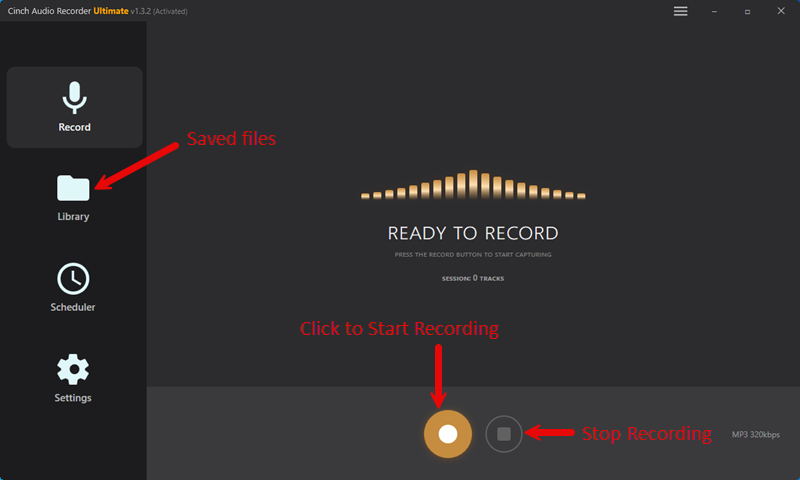
Step 2: Launch the Cinch Recorder and start recording Traxsource music
– launch the Cinch and click the record button on the upper left
– Open Traxsource on your web browser or your desktop app, and find the music you want to record and play it. The Cinch starts to record the music and save it as MP3 or WAV on your computer automatically.
Step 3: Find the recorded MP3 files
– On the interface of Cinch, right-click on the recorded file you want and select “Open output folder”. You will see the output folder where the recorded files are stored.

How to Backup Your Traxsource Music on Cloud
Useful if you need tracks on multiple devices—laptop, phone, tablet.
On Computer:
- Create a free Dropbox account if you don’t have one
- On Traxsource, go to Downloads
- Click Send to Dropbox
- Authorize the connection → click Save
On Phone/Tablet:
- Install the Dropbox app
- Log into Traxsource in your mobile browser
- Go to your Downloads page
- Tap Download to Dropbox
Files sync automatically. Handy for last-minute gig prep.
⚠️ The Download Window Problem
Here’s what the other guides don’t tell you.
Traxsource limits how long you can download purchased tracks. Based on user reports and my own experience, the window is approximately 7 days. After that, the download button disappears.
Why? To prevent account sharing. If downloads were unlimited forever, one person could buy tracks and let 10 friends download them on different machines.
What to do if your downloads expired:
- Contact Traxsource customer support
- Explain you need to re-download on a new device
- They usually re-enable downloads for a short period
According to several Reddit threads, support is generally responsive about this. But it’s an extra step you shouldn’t need if you plan ahead.
Best Practice: Download immediately after purchase. Back up to an external SSD. Don’t rely on being able to re-download later.
One user on r/DJs put it bluntly: “It can be a very expensive mistake to not have at least one copy of all of your files.”
Comparison: Official vs. Third-Party Downloaders
| Feature | Official Traxsource | Cinch/Leawo/ViWizard/TunesKit/DRmare |
|---|---|---|
| Price | Pay per track | One-time software fee/free trial |
| Output Formats | MP3, WAV, AIFF | MP3, AAC, WAV, FLAC, etc. |
| Audio Quality | Up to lossless | Up to 320kbps (MP3), varies by tool |
| Batch Download | Yes (Download Manager) | Yes (batch recording) |
| ID3 Tag Editing | No | Yes |
| Ad Filter | No | Some tools (e.g., Cinch) |
| Ringtone Maker | No | Some tools (e.g., Cinch) |
| Device Compatibility | Universal | Universal |
| Legal Risk | None | Possible (check local laws/ToS) |
Pros and Cons
- Official: Legal, high quality, supports artists, but paid and limited to available formats.
- Third-party: Flexible, supports more formats, batch features, but may violate ToS and copyright.
When to Choose
- Beginners and those who want to support artists: Use official methods.
- Advanced users, DJs, or those needing more flexibility: Consider third-party tools.
MP3 vs WAV vs FLAC: What Do Pro DJs Actually Use?
This debate never dies. Every DJ forum has the same argument: “Real DJs use lossless” vs “Nobody can hear the difference.”
Here’s what the data actually shows.
The Audiophile Argument
WAV and FLAC are lossless. They preserve every bit of the original master. MP3 is lossy—it throws away data the encoder considers “inaudible.”
In theory, lossless is better. In practice? Double-blind studies consistently show most listeners can’t distinguish 320kbps MP3 from lossless. Even trained audio engineers struggle in controlled tests.
One DJ on Reddit summed it up: “Zero ppl in the crowd are going to say ‘omg he’s playing a 320 and not a FLAC, I can’t stand this DJ.'”
The Storage Reality
Let’s do the math.
| Format | Average File Size (5-min track) | 10,000 Tracks |
|---|---|---|
| MP3 320kbps | ~10 MB | ~100 GB |
| FLAC | ~30-50 MB | ~300-500 GB |
| WAV | ~50 MB | ~500 GB |
A MacBook with 512GB storage can hold your entire MP3 library with room to spare. Switch to lossless, and you’re buying external drives or upgrading to 1TB+ (which costs $300+ on Apple hardware).
Many working DJs keep lossless archives on a NAS at home, but load their laptop with 320kbps MP3s for actual gigs. Practical beats theoretical.
When to Buy WAV/FLAC
Lossless makes sense in specific scenarios:
- Remixing or mashup production — You need the cleanest possible source material
- Festival main stages — Massive sound systems with audiophile-grade equipment
- Archival purposes — Future-proofing your collection
- Personal preference — Some people just want the best, regardless of practical difference
For regular club gigs, bar sets, or mobile DJ work? 320kbps MP3 is fine. Actually, it’s more than fine. It’s what most record pools provide.
How to Verify Your Download Quality
Here’s a concern that comes up on Reddit: “Did Traxsource sell me a fake 320kbps file?”
Some users run their downloads through Spek (a free spectrum analyzer) and see the audio cutting off at 16kHz instead of 20kHz. That looks like a 192kbps file transcoded to 320kbps. Scam?
Usually not.
What’s Actually Happening
Many producers apply a low-pass filter during mastering. They intentionally cut frequencies above 16kHz. This is a creative choice, not a quality issue.
When you see a “shelf” at 16kHz in Spek, it could mean:
- Mastering decision — The producer filtered high frequencies
- Transcoded file — The source was lower quality (rare on legitimate stores)
- Codec artifact — Modern MP3 encoders don’t always create hard cutoffs
How to Use Spek
- Download Spek (free, open source) from spek.cc
- Drag your MP3 file into the window
- Look at the spectrogram
What to look for:
- True 320kbps typically extends to ~20kHz
- A hard cutoff at exactly 16kHz or 19kHz suggests transcoding
- Gradual rolloff is usually intentional mastering
What If Quality Is Actually Poor?
Traxsource has a reputation for good customer service. If you genuinely believe you received a low-quality file:
- Contact support with your Spek analysis
- Request a refund or replacement
- Consider buying the WAV version to compare
In most cases, the “low quality” is actually just how the track was mastered. But it never hurts to verify.
Troubleshooting Common Traxsource Download Issues
| Problem | Likely Cause | Solution |
|---|---|---|
| Download button missing | Past the 7-day window | Contact Traxsource support to re-enable |
| Can’t download on new computer | Same as above | Support can reset your download access |
| File shows low bitrate in Spek | Producer’s mastering choice | Usually not a quality issue; contact support if concerned |
| Dropbox sync failed | Account not properly linked | Re-authorize Dropbox connection in Traxsource settings |
| Download Manager won’t start | Windows compatibility issue | Try running as administrator, or use browser download instead |
| Payment declined | Card/PayPal issue | Try different payment method; check with your bank |
Pro tip: If you’re having persistent issues, try a different browser. Some users report better luck with Chrome or Firefox over Safari.
FAQs
Can I download from Traxsource for free?
Not the full tracks. Traxsource is a paid store. You can use audio recording software to capture the 2-minute preview clips, but complete songs require purchase.
How long can I download after buying?
Approximately 7 days. After that, contact customer support to request re-enabled downloads. They’re usually accommodating, but it’s an extra step.
Is Traxsource MP3 quality good enough for club gigs?
Yes. Traxsource provides 320kbps MP3, which is indistinguishable from lossless in virtually all club environments. For festival main stages or studio production, consider WAV.
Can I upload my own music to Traxsource?
Not directly. You need to go through a distributor like iMusician, DistroKid, or similar services. They handle the submission and take a percentage of sales.
Why does my Traxsource MP3 show low frequency in Spek?
Usually a mastering choice by the producer, not a quality issue. Many tracks are intentionally filtered above 16kHz. If you’re concerned, contact Traxsource support or compare with the WAV version.
Legal and Ethical Considerations
When converting Traxsource music to MP3, consider these important legal points:
- Personal Use Only: Conversion should be limited to tracks you’ve legitimately purchased
- Copyright Respect: Never distribute converted files to others
- Artist Support: Continue purchasing music to support creators
- Terms of Service: Be aware that some conversion methods may conflict with Traxsource’s terms
We strongly recommend purchasing music through official channels to ensure artists and labels receive proper compensation for their work.
Wrapping Up
Downloading from Traxsource is straightforward—once you know the rules. Buy your tracks, download within the 7-day window, and back up immediately. Don’t assume you can re-download forever.
For format choice, 320kbps MP3 handles 99% of DJ scenarios. Save lossless for production work or archival.
And if you need to capture preview clips or record from other streaming sources, tools like Cinch Audio Recorder can help—just remember you’re limited to whatever the source lets you play.
The most important thing? Back up your files. External SSD, cloud storage, whatever works. Losing a library you paid hundreds of dollars for is a mistake you only make once.