It’s Sunday afternoon. You’re finally cleaning up your phone—deleting old apps, organizing photos, and you realize: you’ve had the same generic ringtone for two years. That song you’ve been playing on repeat? That should be your ringtone.
But Spotify doesn’t have a button for that. You tap around the app. Settings. Nothing. You Google it. Results are either selling you software or buried in technical jargon.
Here’s the practical answer: Android users can do this in about 5 minutes with free online tools. iPhone users need 15 minutes and GarageBand (also free). Neither requires a Spotify Premium subscription.
The catch? Spotify encrypts its files. You can’t just copy a “downloaded” song to your ringtone folder. But any audio that plays through your speakers can be captured—this is the technical principle behind all three methods.
Pick your path: Method 1 for Android (quickest), Method 2 for iPhone (free but more steps), or Method 3 for desktop users who want to process multiple songs.
In This Article:
Quick Answer
No, Spotify doesn’t offer a “set as ringtone” feature. The songs you download are encrypted and only play inside Spotify’s app. To use them as ringtones, you need to record or convert the audio first—then set it through your phone’s settings. This guide shows you how.
Why Spotify Doesn’t Make This Easy
Spotify encrypts every song you stream or download. This is DRM—Digital Rights Management.
Under the hood, when you hit play, Spotify’s server sends an encrypted audio stream. Your app decrypts it in real-time and plays it through your speakers. The file never exists as a regular MP3 on your device.
This is why you can’t just copy a “downloaded” Spotify song to your ringtone folder. The file isn’t there—it’s a cached, encrypted blob that only Spotify’s app can read.
Official Source: According to Spotify’s Terms of Service, downloaded content is “made available to you for your personal, non-commercial use” and cannot be “reproduced, transferred, distributed, or sold.”
But here’s the thing: any audio that plays through your speakers eventually becomes an analog signal. This is the “analog hole” in DRM protection. Recording software captures that signal—at the system audio level, not by cracking encryption.
Fun detail: This is exactly how Cinch Audio Recorder works. It records at the system audio layer while you play the song. No DRM bypass needed—just capturing what you already hear.
What You’ll Need Before You Start
For Android:
- Your Android phone
- An online Spotify-to-MP3 converter (free)
- The song’s Spotify link
For iPhone:
- Your iPhone
- GarageBand (free from App Store)
- The audio file (MP3 or similar)
- Optional: A Mac or PC to get the audio file first
For Desktop Recording (Cinch):
- Windows or Mac computer
- Cinch Audio Recorder
- Spotify desktop app or web player
Method 1: Android Quick Method
Android makes this straightforward. Most phones accept MP3 files as ringtones without conversion.
Step 1: Get the Song as an MP3
You need the audio file outside Spotify. Two options:
Option A: Online Converter (Free)
- Open Spotify on your phone
- Find the song you want
- Tap the three dots → Share → Copy link
- Go to an online Spotify-to-MP3 converter in your browser
- Paste the link and download the MP3
Option B: Transfer from Computer
If you already have the MP3 on your computer, connect your phone via USB and copy it to the Music folder.
Step 2: Set as Ringtone
- Open Settings on your Android
- Go to Sound & Vibration (or Sounds and Haptics)
- Tap Ringtone or Phone Ringtone
- Tap the + or Add button
- Navigate to your downloaded MP3
- Select it and tap Done
Works well when: You want one ringtone quickly, and you’re comfortable using online tools.
Falls short when: You need multiple ringtones (each takes 5+ minutes), or the online converter has ads/limits.
User Feedback: On Reddit, users report mixed experiences with online converters—some work reliably, others have daily limits or poor audio quality. Source: r/techsupport
Method 2: iPhone with GarageBand
iPhone requires M4R format for ringtones, with a maximum length of 30 seconds. GarageBand handles this for free.
Step 1: Get the Audio File
First, you need the song as an MP3 on your iPhone. Options:
- Download via online converter on your iPhone’s browser
- Transfer from computer via AirDrop or Files app
- Email it to yourself and save the attachment
Step 2: Import into GarageBand
- Open GarageBand (download free from App Store if needed)
- Tap the + to create a new project
- Choose Audio Recorder or any instrument
- Tap the loops icon (top right, looks like a loop)
- Switch to Files tab
- Tap Browse items from the Files app
- Locate your MP3 and tap to import
Step 3: Trim to 30 Seconds
- The audio appears as a waveform
- Tap the + in the top right → Section A
- Turn on Automatic and set length to 30 bars (about 30 seconds)
- Drag the audio to the section you want (chorus works best for ringtones)
- Adjust start and end points by dragging the waveform edges
Step 4: Export as Ringtone
- Tap the down arrow (top left) → My Songs
- Long-press your project → Share → Ringtone
- Name your ringtone and tap Export
- Tap Use sound as → Standard Ringtone
Works well when: You want a free solution and don’t mind a learning curve.
Falls short when: You need to make many ringtones (each takes 15+ minutes), or you’re uncomfortable with GarageBand’s interface.
One honest limit: GarageBand is powerful but not intuitive. The first ringtone takes longer while you learn the workflow.
User Feedback: “Download Garage Band and you can create ringtones. There are plenty of guides on how to do it.” — Reddit r/iphone
Method 3: Desktop Recording with Cinch
If you’re making multiple ringtones—or want an easier workflow—desktop recording software automates the process.
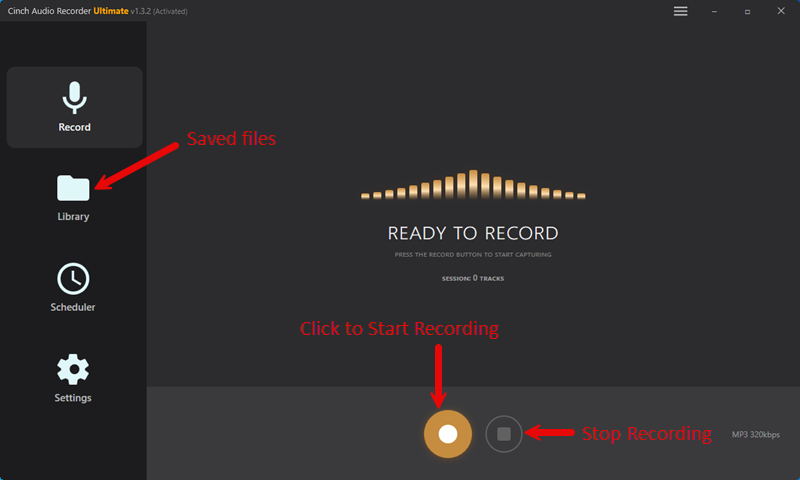
Cinch Audio Recorder records any audio playing through your computer’s speakers. It works with Spotify, YouTube, Apple Music, and other streaming services.
Step 1: Install and Launch
- Download Cinch from the official site
- Install and open the program
- Click the red Record button
Step 2: Play Your Song
- Open Spotify (desktop app or web player)
- Play the song you want to record
- Cinch automatically detects and records the audio
- It stops recording when silence is detected or you click Stop
Step 3: Find Your Recording
- Go to the Library tab in Cinch
- Your recording appears with automatic metadata (song title, artist, cover art)
- Right-click → Open Folder to find the MP3 file
Step 4: Make a Ringtone
Cinch has a built-in ringtone maker:
- Right-click any song in your Library
- Select Make Ringtone
- Set start and end times (max 30 seconds for iPhone)
- Choose format: M4R for iPhone or MP3 for Android
- Click Export
Step 5: Transfer to Your Phone
For iPhone:
- Connect via USB
- Open iTunes/Finder
- Drag the M4R file to Tones section
- Sync your iPhone
For Android:
- Connect via USB
- Copy the MP3 to your phone’s Music folder
- Set as ringtone through Settings
Works well when: You want to process multiple songs, prefer automation, or need consistent quality.
Falls short when: You only need one ringtone (free methods work fine), or you don’t have a computer.
Download Cinch Audio Recorder


Which Method Should You Choose?
| Method | Max Quality | Time Cost | Failure Risk | Best For |
|---|---|---|---|---|
| Android Online Tool | Up to 320kbps | 5 min | Low (some tools have ads) | Quick one-off ringtones on Android |
| iPhone GarageBand | Up to 320kbps | 15 min | Medium (learning curve) | Free iPhone method, patient users |
| Cinch Recording | Up to 320kbps | Real-time + 2 min | Low | Multiple ringtones, desktop users |
Quick decision:
- Android user? Use Method 1. It’s the fastest path.
- iPhone user with one ringtone? Use Method 2 (GarageBand). Free and works well once you learn it.
- Making multiple ringtones? Use Method 3 (Cinch). The time savings add up.
What’s Actually Possible?
Let’s set realistic expectations before you start.
Audio quality: Your ringtone will sound as good as the source. Spotify Free streams at 160kbps. Spotify Premium streams at up to 320kbps. When you record or convert, you’re capturing that quality level—not improving it.
What this means in practice: A ringtone recorded from Spotify Premium will sound crisp and clear through your phone’s speakers. One recorded from Spotify Free will still sound fine—most people won’t notice the difference on a phone speaker.
Format limitations:
- iPhone: M4R format, max 30 seconds. No exceptions—this is an iOS limitation.
- Android: MP3, M4A, WAV, or OGG. Length varies by device, but 30 seconds is a safe standard.
Time investment:
- First ringtone: 15-30 minutes (learning curve included)
- Subsequent ringtones: 5-15 minutes each
- With Cinch: Real-time recording + 2 minutes processing per song
One honest limit: You cannot improve audio quality beyond what Spotify streams. “Lossless” ringtones from Spotify aren’t possible because the source isn’t lossless. That said, 320kbps MP3 is more than sufficient for a ringtone—you’re not listening critically when your phone rings.
Best Practices for Better Ringtones
Through testing dozens of ringtones, I’ve found these practices make the difference between a ringtone that works and one that annoys:
1. Pick a recognizable section
The chorus is usually best. The first 30 seconds often include a slow intro that doesn’t work as a ringtone. Find the most memorable part—the hook that makes people sing along.
2. Test before committing
Set the ringtone, then have someone call you. Does it grab your attention? Can you hear it from another room? Some songs sound great through headphones but get lost in ambient noise.
3. Avoid quiet sections
Spotify normalizes volume across tracks, but quiet interludes won’t cut through background noise. Look for sections with energy and presence.
4. Keep a backup
Save your trimmed ringtone files somewhere safe—cloud storage, a dedicated folder, or email them to yourself. If you get a new phone, you won’t want to repeat the entire process.
5. Consider multiple ringtones
Different ringtones for different contacts help you know who’s calling without looking at your phone. This is where Cinch’s batch processing saves significant time compared to doing each one manually.
6. Match the format to your device
Don’t fight the system. iPhone needs M4R. Android prefers MP3. Trying to force other formats often leads to silent or distorted ringtones.
7. Check your phone’s volume settings
Some phones have separate ringtone volume from media volume. A perfectly good ringtone won’t work if your ringtone volume is set to zero.
Troubleshooting Common Issues
“The online converter didn’t work”
Cause: Some converters have daily limits, server issues, or poor reliability.
Fix: Try a different converter, or use the desktop recording method. Cinch records directly from your computer’s audio output—no reliance on third-party servers.
“GarageBand won’t import my file”
Cause: GarageBand supports MP3, M4A, WAV, and AIFF. Some formats (like OGG or FLAC) may not import directly.
Fix: Convert the file to MP3 first using a free online audio converter, then import into GarageBand.
“My iPhone ringtone is silent”
Cause: The M4R file may be longer than 30 seconds, or wasn’t properly synced.
Fix:
- Check the file length in iTunes/Finder (must be under 30 seconds)
- Delete and re-sync the ringtone
- Restart your iPhone and check Settings → Sounds & Haptics → Ringtone
“The ringtone quality sounds bad”
Cause: Low bitrate source, or the converter compressed the audio too much.
Fix:
- Use a higher quality source (Spotify Premium streams at higher quality than Free)
- With Cinch, set recording quality to 320kbps in Settings
- Avoid re-compressing already-compressed files
“I can’t find my Spotify downloads in my phone’s files”
Cause: Spotify downloads are encrypted cache files, not regular audio files. You can’t access them directly.
Fix: This is expected behavior. Use one of the methods above to record or convert the audio instead.
FAQ
Can I set a Spotify song as my ringtone directly?
No. Spotify songs are encrypted and can only be played within the Spotify app. You need to record or convert the audio first, then set it as a ringtone through your phone’s settings.
Do I need Spotify Premium to make a ringtone?
No. Free Spotify users can use any of these methods. However, Premium users get higher streaming quality (up to 320kbps), which may result in better-sounding ringtones.
What’s the difference between MP3 and M4R?
MP3 is a universal audio format. M4R is Apple’s ringtone format, which is essentially a renamed AAC file. iPhone requires M4R for custom ringtones. Android accepts MP3 directly.
Is this legal?
Recording streaming audio for personal use is generally considered acceptable in most jurisdictions, similar to recording radio broadcasts. However, redistributing recorded content or using it commercially violates copyright law and Spotify’s Terms of Service.
Always respect artist rights. Use recorded content only for personal purposes.
Can I use Spotify songs as alarms too?
Yes. The same methods work for setting Spotify songs as alarms. After you have the MP3 or M4R file, set it through your clock app’s alarm sound settings.
How long can a ringtone be?
iPhone ringtones must be 30 seconds or shorter. Android phones typically accept longer files, but 30 seconds is a good standard length—most calls are answered or go to voicemail within that time.
Can I make ringtones from Apple Music too?
Yes, but Apple Music has the same DRM protection. You’ll need similar methods—recording or conversion—to use Apple Music songs as ringtones.
Legal Note
This guide explains technical methods for creating personal ringtones from streaming audio. Recording copyrighted content may violate Spotify’s Terms of Service. Only use recorded audio for personal purposes. Do not redistribute or sell ringtones created from copyrighted music.
Respect artists and their work. If you love a song enough to make it your ringtone, consider supporting the artist through official channels.