Quick Summary
In this article, we find out by following the history of Grooveshark.com. We also look at its services and the controversy surrounding its copyright violations.
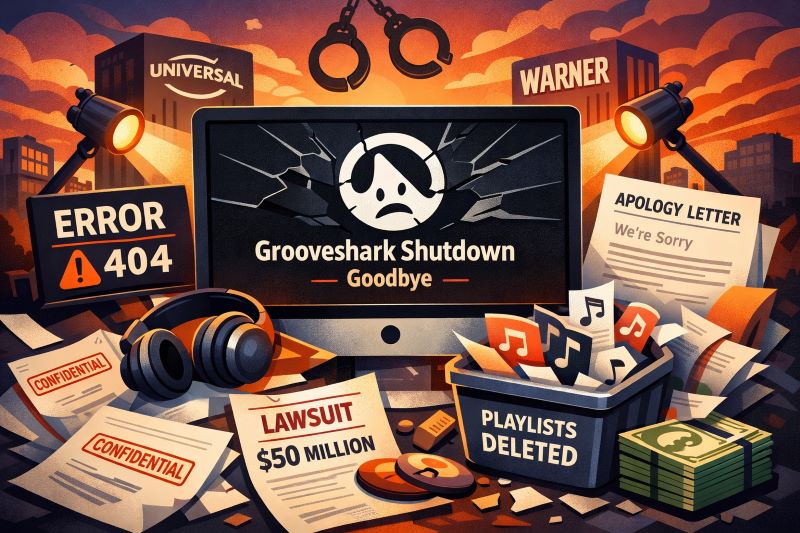
On April 30, 2015, Grooveshark(Grooveshark.com) disappeared. No warning, no export tool, no grace period. Thirty-five million users woke up to a black screen and an apology letter. Years of playlists—gone.
The service didn’t fail because of market competition or lack of users. It was sued out of existence by Universal, Sony, and Warner. But here’s what makes Grooveshark different from other shutdowns: it didn’t die because users uploaded copyrighted music. YouTube has that problem too. Grooveshark died because its own employees uploaded the pirated songs themselves—and got caught. The internal emails became courtroom evidence. The legal defense collapsed. And the settlement cost $50 million.
What Was Grooveshark

Grooveshark launched in March 2006 as a peer-to-peer music service. Founded by three University of Florida undergraduates—Sam Tarantino, Josh Greenberg, and Andrés Barreto—it started as a platform where users could buy and sell MP3s. By 2007, it had pivoted to free streaming.
Think of it as YouTube for audio, but with almost no content moderation. Users uploaded songs from their personal libraries, and those songs became instantly streamable for everyone. The result was a catalog far more eclectic than anything licensed services could offer: DJ mixtapes, unreleased demos, live recordings from small venues, fan-made remixes, and obscure tracks that never made it to iTunes.
At its peak around 2011, Grooveshark claimed over 35 million monthly users. It was the go-to platform for music discovery, especially for genres and artists that mainstream services ignored. The interface was simple—type a song name, hit play, and you were listening within seconds.
But there was a fundamental problem. Grooveshark didn’t have licenses for most of the music it streamed.
Why Grooveshark Shut Down
On April 30, 2015, Grooveshark posted a message on its homepage and went dark. The message was blunt: “We failed to secure licenses from rights holders for the vast amount of music on the service. That was wrong. We apologize. Without reservation.”
The shutdown was part of a settlement with Universal Music Group, Sony Music Entertainment, Warner Music Group, and several other labels. The terms were severe:
- Permanent closure of the service
- A $50 million payout to the record companies
- Transfer of Grooveshark’s website, apps, and intellectual property to the Recording Industry Association of America (RIAA)
- Additional penalties if the company violated the settlement
Before the settlement, Grooveshark faced potential damages of up to $736 million. Even a fraction of that amount would have bankrupted the company. Settlement was the only realistic option.
But why was Grooveshark liable at all? Other platforms host user-uploaded copyrighted content all the time. The answer lies in a legal concept called “safe harbor”—and Grooveshark’s failure to qualify for it.
The DMCA Safe Harbor Violation
Grooveshark lost its legal case for one specific reason: its own employees uploaded copyrighted music. That single fact disqualified the company from the DMCA “safe harbor” protections that saved YouTube.
The Digital Millennium Copyright Act (DMCA) includes “safe harbor” provisions that protect online platforms from copyright liability for content uploaded by users. If a user uploads a pirated movie to YouTube, YouTube isn’t automatically liable—as long as it responds to takedown requests from copyright holders. This is why YouTube can exist despite millions of copyrighted uploads.
Grooveshark tried to claim this same protection. It failed.
The court found that Grooveshark employees—including co-founders Sam Tarantino and Josh Greenberg—had personally uploaded 5,977 copyrighted songs to the platform. These weren’t a few rogue tracks. Internal emails showed that Greenberg had sent a company-wide directive in 2007 telling employees to upload music from their personal libraries:
“Please, please, please, I need everyone to help out on this one. […] Download as much as you possibly can. The more the better. I don’t care if it’s 10,000 songs or 100,000 songs. Just get them on the site.”
This wasn’t users uploading content. This was the company itself building its music library with copyrighted material. That distinction mattered enormously.
When a platform’s own employees are the source of infringement, safe harbor protection evaporates. The court was blunt: Grooveshark had intentionally built its business on copyright violations. YouTube survived because it had policies against employee uploads and functioning takedown systems. Grooveshark had neither—and its own executives were caught red-handed.
Making matters worse, the court found that Grooveshark had destroyed evidence. Upload logs and source code that might have shown the full scope of employee uploads were deleted. This “bad faith” destruction led to additional sanctions.
The Tragic Aftermath
The toll of the lawsuit extended beyond the company itself. Just months after the grueling $50 million settlement and the shutdown of the site, co-founder Josh Greenberg was found dead in his home at the age of 28. While authorities found no evidence of foul play or suicide, it marked a tragic and abrupt end to the story of the young college students who tried to rewrite the rules of the music industry.
What Made Grooveshark Special
Grooveshark’s P2P model created something modern streaming services can’t offer: a music catalog limited only by what users had, not by what labels approved.
Users could find:
- Underground hip-hop mixtapes that were only sold at shows
- Unofficial remixes and mashups that artists never officially released
- Live recordings from concerts and radio sessions
- Demo versions of songs that were never commercially distributed
- Obscure electronic music from defunct labels
- International music that never got a proper US release
When Grooveshark shut down, that catalog disappeared. Some of those tracks have resurfaced on YouTube, SoundCloud, or Bandcamp. But a significant portion of Grooveshark’s library existed in a gray zone—it was never officially licensed, so it never made it to Spotify or Apple Music.
Modern streaming services operate on strict licensing agreements. If a label doesn’t approve a track, it doesn’t appear on the platform. This is better for artists and rights holders, but it means that “wild” music—the unpoliced corners of music culture—is increasingly hard to find legally.
Grooveshark was the last major platform where the catalog was limited only by what users had in their personal collections, not by what rights holders had approved. Its closure marked the end of an era.
The Ownership Crisis in Streaming
Grooveshark’s shutdown illustrates a broader problem with streaming that’s still relevant today: you don’t own anything.
When Grooveshark went dark, 35 million users lost access to years of curated playlists. There was no grace period. No export tool. No backup. One day you had a carefully organized music library; the next day, it was gone.
This wasn’t unique to Grooveshark. Streaming services routinely remove content due to licensing disputes. In 2024, TikTok’s music licensing conflicts led to widespread song removals. Spotify users regularly report songs disappearing from their playlists when licenses expire or rights change hands. Apple Music deleted user libraries by accident. Murfie, a cloud storage service for music, shut down and initially threatened to destroy customer collections.
The pattern is consistent: streaming services are rentals, not ownership. You pay for access, but that access can be revoked at any time—for any reason—with little or no warning.
This doesn’t mean streaming is bad. It’s convenient, affordable, and legal. But it does mean that if you care deeply about specific songs—especially rare or obscure tracks—you shouldn’t rely solely on a streaming service to preserve them.
How to Build Your Own “Alternative” (And Protect Your Music)
If you’re reading this as a former Grooveshark user, the past can’t be undone. Your playlists are gone. But you can protect yourself going forward.
Don’t assume streaming equals ownership. Any song on Spotify, Apple Music, or YouTube Music could disappear tomorrow. Licensing agreements change, artists pull their catalogs, and platforms shut down.
Keep local copies of important music. If there’s a song you absolutely need to have—especially a rare track, a specific remix, or something from an independent artist—record it and save it as a local file. Tools like Cinch Audio Recorder can capture any audio playing on your computer and save it as an MP3. It’s not elegant, but it ensures that a platform shutdown can’t take your music with it.
Export your data. Services like Soundiiz let you export your playlists to files. If your streaming service disappears, you’ll at least have a record of what was in your library.
Consider purchasing music. Bandcamp, the iTunes Store, and Amazon Music let you buy tracks as files you actually own. They cost more per song than streaming, but those files are yours.
Grooveshark’s story ended in court, but the problem it exposed is still with us. Platforms come and go. Licensing deals expire. Catalogs get pulled. If you’ve spent years building a music library on a service you don’t control, you’re gambling that the service will outlast your interest in the music. Sometimes it won’t. Keep a copy of what matters.
List of alternatives to Grooveshark
There are many legal alternatives to Grooveshark where you can stream music for free or at a low cost. The 13 best free music streaming alternatives to Grooveshark in 2022.